The Complete Guide to Matching Music Tempo to Your Actual Training Zone
Quick Answer: Different training zones respond best to different tempo ranges — roughly 120-140 BPM for steady endurance cardio, 140-170+ BPM for high-intensity intervals, and a much wider, more flexible range for strength training where rhythm matters less than mood and motivation. Matching tempo to zone measurably improves perceived effort and consistency, not just enjoyment.
Most people build workout playlists around personal taste alone, which works fine casually but leaves real performance benefit on the table. Understanding how tempo interacts with different training zones changes how you build a playlist for a specific type of session.

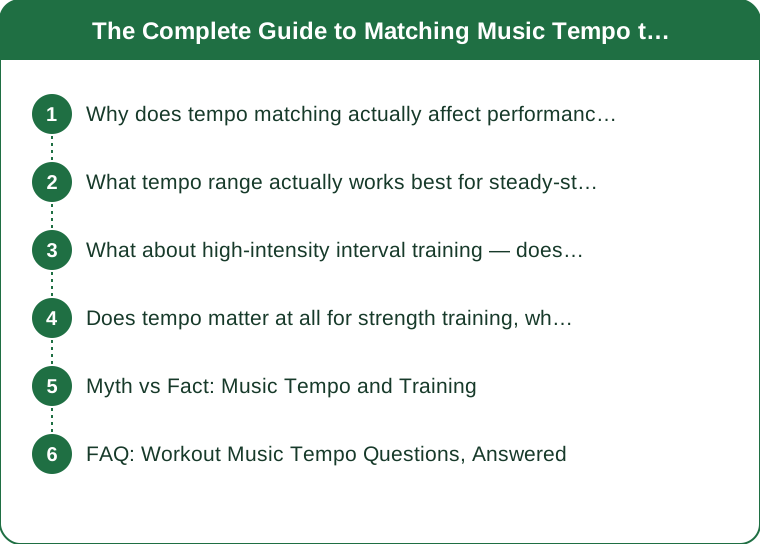
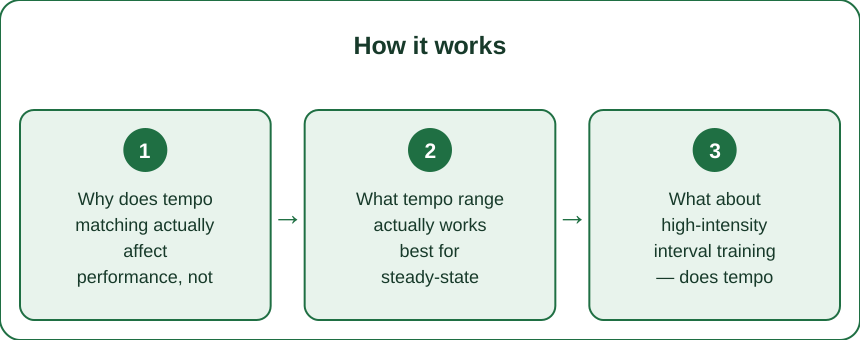
Why does tempo matching actually affect performance, not just mood?
Research on exercise and music consistently shows that a rhythmic auditory cue can entrain movement patterns — runners and cyclists in particular tend to unconsciously sync stride or pedal cadence to a strong, steady beat, which can improve movement efficiency and reduce perceived effort at a given intensity. This effect is strongest when the tempo is reasonably close to your natural movement cadence, not simply the fastest song available.
Beyond the physical entrainment effect, tempo also interacts with psychological arousal — faster tempo music reliably increases perceived energy and motivation, which is part of why upbeat music makes hard efforts feel more manageable, independent of any physical cadence-matching.
What tempo range actually works best for steady-state cardio?
For most people running, cycling, or doing steady cardio at a moderate, sustainable pace, 120-140 BPM aligns well with natural cadence for many common paces — a stride rate around 160-180 steps per minute for running often pairs naturally with music in the upper half of this range or with music at half that tempo (since many people step on every other beat).
The key isn’t finding one ‘correct’ number — it’s noticing whether a song’s beat naturally seems to match or fight your movement rhythm, and building a steady-state playlist around songs that match rather than fight it.
What about high-intensity interval training — does tempo matter more or less?
More, in a specific way: during the actual work interval, faster tempo (roughly 140-170+ BPM) correlates with higher perceived motivation and can support pushing closer to true maximum effort, since the psychological arousal effect of fast tempo music is especially useful during short, intense bursts where mental push matters as much as physical capacity.
During rest intervals, a deliberate shift to slower tempo or no music at all can support genuine recovery breathing rather than staying artificially amped up between hard efforts — a detail most interval playlists miss by keeping the same high-energy track running throughout.

Does tempo matter at all for strength training, where movement isn’t continuous and rhythmic?
Less directly, since lifting doesn’t have the same continuous rhythmic cadence as running or cycling. The psychological arousal effect still applies, though — many lifters report better focus and intensity on heavy compound lifts with music they find personally energizing, regardless of specific BPM. For strength training, mood and personal motivation matter more than precise tempo matching, which is the opposite emphasis from cardio training.
Myth vs Fact: Music Tempo and Training
Myth: Faster is always better for workout music, regardless of the type of training. Fact: Faster tempo helps most clearly during sustained cardio and high-intensity intervals; for strength training and recovery periods, tempo matters far less than personal motivation and mood.
Myth: You need to precisely calculate BPM to match your cadence for any benefit. Fact: Rough alignment — noticing whether a song’s beat feels like it’s helping or fighting your movement — captures most of the benefit without needing exact calculation.
FAQ: Workout Music Tempo Questions, Answered
How do I find out my own running cadence to match music tempo to it?
Many fitness watches and running apps track steps per minute automatically; alternatively, count your steps for 15 seconds during a comfortable run and multiply by four for an estimate.
Is there a downside to always training with high-BPM music?
Yes — constantly high-arousal music during rest periods or lower-intensity recovery sessions can prevent the parasympathetic ‘down-regulation’ that proper recovery needs, so varying tempo to match the actual training goal matters.
Do tempo-matching apps and playlists actually work as advertised?
Many BPM-based workout playlist apps are reasonably effective at grouping songs by tempo accurately; the main variable left to the individual is picking genres and songs within that tempo range that are personally motivating, since the psychological effect still depends heavily on individual music preference.
TL;DR:
- Different training zones respond best to different tempo ranges, not one universal ‘best BPM’
- Steady-state cardio benefits from tempo around 120-140 BPM aligned with natural movement cadence
- High-intensity intervals benefit from faster tempo (140-170+ BPM) during work, slower during rest
- Strength training benefits more from personal motivation and mood than precise tempo matching
Building separate playlists by training zone, rather than one all-purpose workout mix, is a small change with a real, research-backed performance payoff.
Keep Reading
This article is for general informational and styling purposes only. Fit, sizing, and product availability may vary.