Noise Cancelling or Transparency? The Complete Guide to Headphone Modes by Workout Type
Quick Answer: Use transparency or ambient mode for anything outdoors, anything involving barbells, and any shared-space class where you need to hear a coach. Use active noise cancelling for treadmills, indoor bikes, and rowing machines, where the dominant sound is meaningless mechanical noise and cancelling it lets you drop your volume by a meaningful amount. The volume reduction is the real health benefit: noise cancelling lets most people listen 10 to 15 decibels quieter for the same perceived experience, which matters over years of training.
Most people pick a mode once, in a store, and never think about it again. It is one of the easiest quality upgrades available.

What are these modes actually doing?
Active noise cancelling works by measuring incoming sound with external microphones and generating an inverted waveform to destructively interfere with it. It is genuinely effective against steady, low-frequency, predictable sound: an HVAC system, a treadmill motor, road noise from traffic, an airplane cabin.
It is much weaker against sudden, irregular, high-frequency sound: a voice, a dropped plate, a bike bell, a car horn. This asymmetry is the entire basis for choosing a mode, and most people misunderstand it. Noise cancelling does not make you deaf to danger — it makes you deaf to background, while leaving you partially aware of sharp events. That is still a meaningful reduction in awareness, but the failure mode is specific.
Transparency or ambient mode does the opposite: it uses the same external microphones to pipe outside sound into your ears, compensating for the physical seal of the earbud. Good implementations sound close to natural. Weaker ones sound thin and hissy, which is why people turn them off and forget they exist.
Adaptive modes try to switch automatically based on detected environment. They work reasonably well for walking and commuting and poorly for exercise, because they interpret your movement and wind as environmental change and shift modes at unhelpful moments. During a workout, choose manually.
The fourth option nobody counts is off — passive isolation only, no processing. Battery lasts longer and some people find it the most natural. On earbuds with a good seal, passive isolation alone blocks a surprising amount.
Understanding this is what makes the rest of the guide obvious rather than arbitrary. You are choosing which category of sound you want removed.
Which mode should you use for outdoor running and walking?
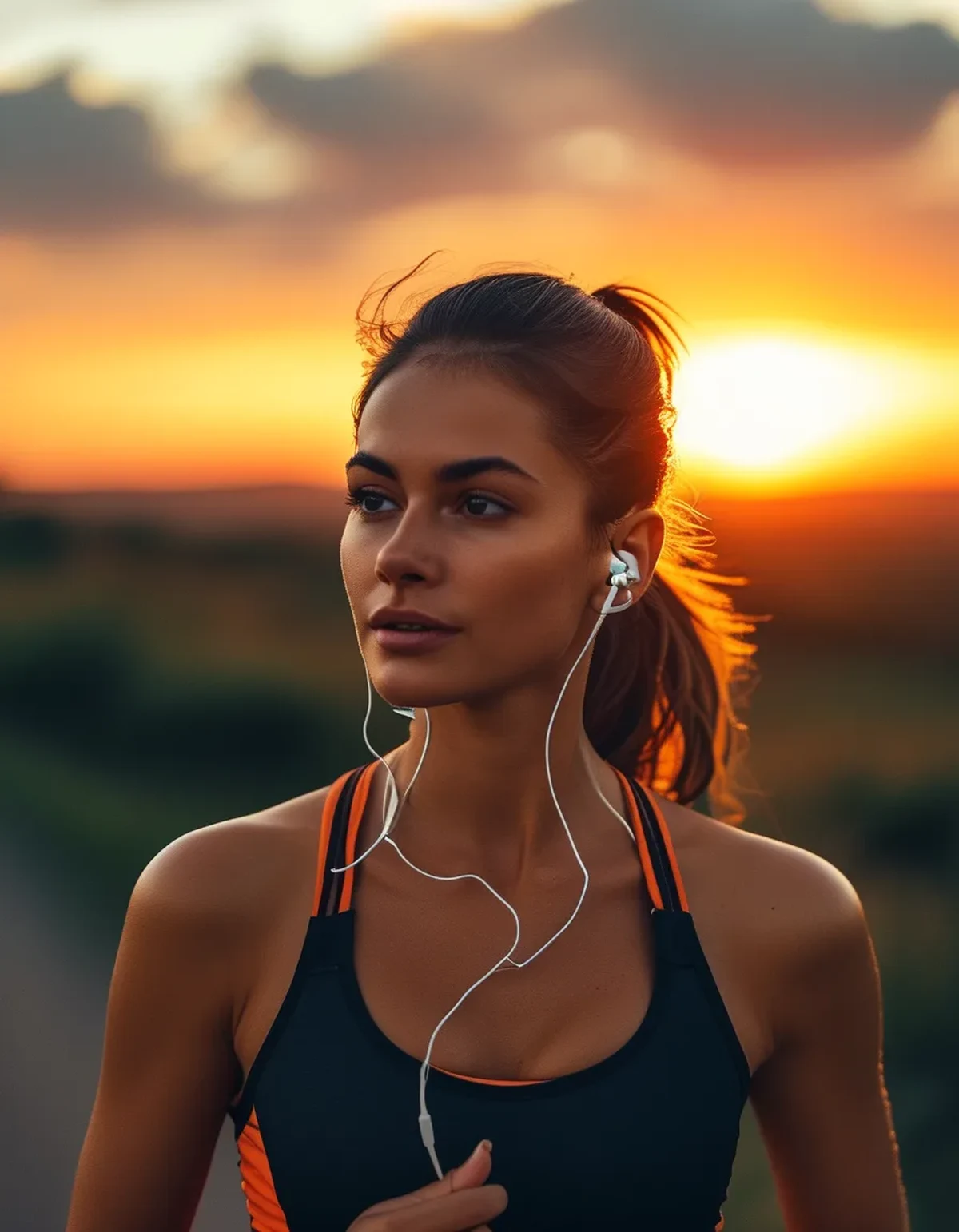
Transparency, without exception, and ideally at a lower volume than you use indoors.
The threat model outdoors is vehicles, cyclists, and other people, and all of those announce themselves with irregular, directional sound. That is precisely the category noise cancelling handles poorly at the low end and eliminates entirely at the high end when your volume is up.
There is a second reason that gets less attention: spatial awareness affects your gait. Runners in full isolation tend to run slightly differently — less scanning, more fixed head position — and on uneven ground or shared paths that raises the chance of an awkward step.
Practical setup for outdoor use:
Keep volume at or below about 60 percent of maximum. If you cannot hear footsteps behind you at your current volume, it is too loud regardless of mode.
Consider open-ear or bone-conduction headphones for regular road running. They sacrifice bass and isolation and give you complete environmental awareness in exchange, and many runners find the trade worth it. They also solve the sweat-seal problem entirely.
Use one earbud only if your headphones lack good transparency. It is a crude solution but far better than full isolation on a road.
Wind is the enemy of transparency mode. Above roughly 10 mph, external mics pick up wind noise as a roar. Better headphones have wind-reduction processing; if yours does not, this is the one outdoor case where switching to off or passive is the more usable choice.
A note on trails: transparency matters just as much. Wildlife, other trail users on blind corners, and the sound of your own footing on loose surface are all information.
Which mode should you use on cardio machines?
Noise cancelling, and this is where it genuinely shines.
A commercial treadmill produces a constant low-frequency motor and belt sound in the range where cancelling is most effective. Indoor cycling studios and gym floors add HVAC roar. Rowers add a loud fan. All of that is steady, predictable, and completely meaningless.
The benefit is not just comfort. Without cancelling, people raise volume to overcome background noise, and gym background noise commonly sits around 75 to 85 decibels. To hear music clearly over that, you end up somewhere well above it. Sustained listening above 85 dB carries real cumulative hearing risk, and a person doing four cardio sessions a week for a decade is accumulating a lot of exposure.
With cancelling on, the background drops substantially and you can lower your volume by 10 to 15 dB for the same subjective experience. That is a large reduction in cumulative dose for a change that takes one tap.
A few caveats specific to machines:
Cancelling can slightly amplify the sensation of your own footfalls and breathing, since the external masking noise is gone. Some people find this unpleasant on a treadmill. It fades with familiarity for most.
If you are in a coached class, use transparency regardless of the machine. Missing an instruction is worse than hearing the fan.
Pressure sensation is real for a minority of people — a feeling of ear pressure with strong cancelling. If you get it, most headphones offer a reduced-cancelling setting.
On a home treadmill in a quiet room, cancelling matters much less, and passive mode with low volume is the healthiest default.
What about strength training and gym floors?
Transparency, and this one surprises people.
The gym floor has genuine safety-relevant sound: someone approaching your blind side while you are under a bar, a plate sliding, a coach calling out, a barbell about to be set down on the platform next to you. Cancelling removes your ability to track any of that in the background.
There is also an etiquette dimension. A person in full isolation cannot be asked to work in, cannot hear a request to move, and is genuinely harder to share a floor with. In a busy fall gym, that friction is real.
There is a performance argument for the opposite view, and it deserves acknowledgment: some lifters use heavy cancelling deliberately to create a bubble of focus before a maximal attempt, and there is decent evidence that pre-lift arousal control improves performance. That is a reasonable use — for the 60 seconds before a heavy single, not for the whole session.
A middle path many people land on:
Transparency for the whole session, cancelling for warm-up sets of your main lift if you need to get your head right.
Take one earbud out during rest periods rather than fiddling with modes. It is faster and it makes you approachable.
Keep volume low enough to hear a dropped weight. If a plate hitting the floor twenty feet away does not register, you are too loud for a shared space.
For home lifting alone, none of this applies and you can do whatever you like — though hearing your own bar path and breathing is more useful feedback than most people realize.
How do sweat, fit, and heat change the equation?
This is the practical dimension that no mode setting can fix, and it is the reason most workout headphone complaints exist.
Seal loss destroys noise cancelling. Cancelling depends on a good acoustic seal, and sweat gradually breaks it. Twenty minutes into a hard session, an earbud that started sealed is often slipping, and cancelling performance falls off sharply — which is why people report that their headphones work fine at the start and badly at the end. The mode did not change. The seal did.
Ear tips matter more than the headphones. Silicone tips get slippery when wet. Foam tips grip far better and maintain seal through sweat, and they usually improve isolation as a side benefit. Swapping tips is a ten-dollar fix for a problem people try to solve with a three-hundred-dollar replacement.
Ear hooks or wingtips solve retention for high-impact work. If your buds fall out during burpees, no listening mode is relevant.
Heat and humidity accelerate everything. Late summer sessions are the worst case: more sweat, softer skin, more slip. This is the season when open-ear designs are most appealing.
Moisture and mics. Sweat on external microphones degrades both cancelling and transparency, sometimes dramatically, and can produce a hissing or crackling artifact. Wipe the outer surfaces after every session and let the buds dry outside the charging case before storing them, because a sealed case is a humid box.
Battery. Cancelling and transparency both cost battery — commonly 20 to 30 percent of runtime. For long sessions, passive mode is a legitimate choice for that reason alone.
Hygiene. Ear tips worn during sweaty exercise should be cleaned weekly. Occlusion plus moisture plus warmth is the same combination that causes problems everywhere else in this magazine, and ears are not exempt.
What Nobody Tells You About Listening Modes
Transparency mode makes your own voice sound normal, and that is a hidden benefit. With a sealed earbud and no processing, your voice reverberates inside your skull — the occlusion effect. It is why people take an earbud out to talk. Transparency largely eliminates it, so you can answer a question mid-set without stopping to remove anything.
Noise cancelling is better at some frequencies than the marketing implies. Most consumer implementations do their real work below about 1 kHz. Above that, you are relying almost entirely on passive isolation from the physical fit. So the tip you use is doing more of the high-frequency blocking than the electronics are.
Your perceived exertion changes with your soundscape. There is reasonable evidence that music lowers perceived effort at submaximal intensities, and part of that effect is dissociation — attention pulled away from breathing and fatigue. Heavy noise cancelling amplifies this, which is great for a long steady effort and unhelpful when you actually need to monitor your body, such as during a return from illness or a first session back after time off.
Volume creep is real and invisible. Over a 45-minute session, most people raise volume gradually as ear fatigue sets in and as the environment gets louder. Setting a volume limit in your phone’s accessibility settings is the single most effective hearing-protection step available, and it takes about thirty seconds to configure.
Adaptive modes get confused by exercise. Your headphones interpret rhythmic movement and wind as environment changes. If your mode seems to shift on its own mid-run, that is why — turn adaptive off and pick manually.
Bone conduction is not automatically safer. People often run bone-conduction headphones louder precisely because there is no isolation, which can offset the awareness benefit. The awareness is the point; the volume still needs managing.
FAQ: Headphone Mode Questions, Answered
Is noise cancelling bad for your ears?
No. The processing itself does not damage hearing, and by allowing lower volumes it is generally protective. The risk in headphone use is volume and duration, not cancellation.
Can I use noise cancelling on an outdoor run if I run in a park with no cars?
It is a judgment call rather than a rule. Even car-free paths have cyclists, dogs, and other runners approaching from behind. If you do it, keep volume low enough that you would hear a shout, and reconsider on shared or blind-corner routes.
Why does my transparency mode hiss?
Usually either an inexpensive microphone implementation, a dirty external mic, or wind. Wipe the outer surfaces first — sweat residue on the mic is by far the most common cause and the easiest to fix.
Do I need different headphones for different workouts?
Most people do fine with one good pair plus foam tips. Runners who do a lot of road mileage often end up with a second open-ear pair, and that is the one genuinely useful split.
What volume is actually safe?
A reasonable rule is 60 percent volume for no more than 60 minutes at a time, with the caveat that gym background noise pushes people higher without noticing. Setting a hard limit in your phone’s settings removes the decision entirely.
Should I use cancelling for yoga or a studio class?
No — you need the instructor. If the studio music is too loud for you, that is worth mentioning to the teacher rather than solving with isolation, because you also need to hear cues about alignment and transitions.
TL;DR:
- Transparency outdoors, on the gym floor, and in any coached class — the sounds that matter there are exactly the ones cancelling handles worst.
- Noise cancelling on treadmills, bikes, and rowers, where it removes meaningless steady noise and lets you drop volume 10 to 15 dB.
- Seal loss from sweat, not the mode setting, is why cancelling degrades mid-session — foam tips fix most of it.
- Turn adaptive modes off during exercise; they misread movement and wind.
- Set a volume limit in your phone settings once, and stop relying on judgment at minute forty.
This is a two-second change you can make before every session, and it affects safety, hearing, and how the workout actually feels. Pick the mode for the room you are standing in, not the one that was set the last time you were on a plane.
Keep Reading
This article is for general informational and styling purposes only. Fit, sizing, and product availability may vary.