The Complete Guide to Building a Workout Playlist That Actually Works
Quick Answer: Music improves exercise performance mainly through two mechanisms — it distracts you from effort sensations at low to moderate intensity, and it regulates arousal at high intensity. Match tempo roughly to your intended cadence, sequence tracks to your workout’s structure rather than shuffling, and accept that the effect is largest for endurance work and smallest for maximal strength efforts. Build around 120 to 140 BPM for most training.
Almost everyone trains with music and almost nobody builds the playlist deliberately. The research here is unusually clear, and the practical implications are easy to apply.

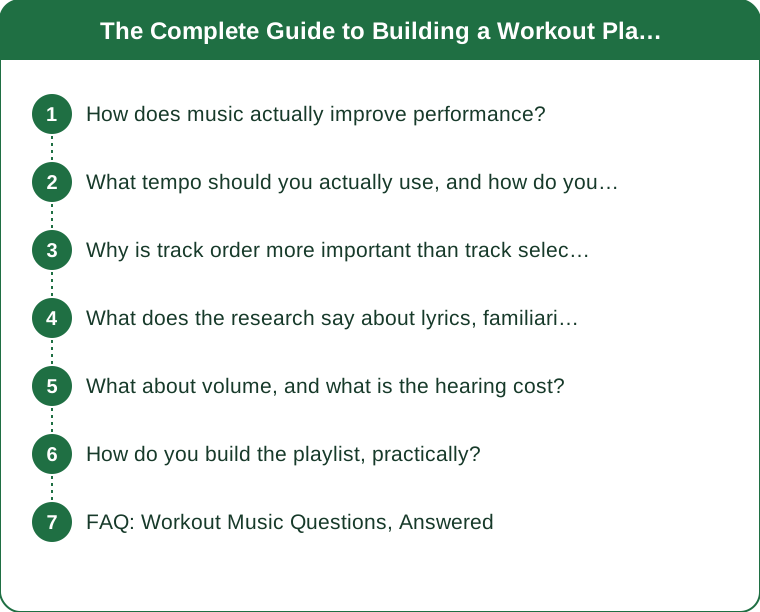
How does music actually improve performance?
Two well-documented mechanisms, and they operate in different intensity ranges.
The first is dissociation. During low to moderate intensity exercise, your attention has spare capacity, and music occupies some of it. Sensations of effort — breathing rate, muscular discomfort, the passage of time — compete with the music for attention, and the music wins some of that competition. The consistent finding across studies is a reduction in rated perceived exertion of roughly 8 to 12 percent at matched workloads. You are doing the same work and it feels easier.
The critical caveat is that this effect fades as intensity climbs. Above roughly your ventilatory threshold — the point where breathing becomes labored and conversation stops — the physiological signals become too loud to ignore, and attention narrows involuntarily onto them. Music does not stop this. At maximal intensity, dissociation effects are essentially absent.
The second mechanism takes over there. Music regulates arousal, meaning it shifts your psychological and physiological readiness state. Fast, loud, high-energy music raises arousal; slow, quiet music lowers it. This matters enormously before and between efforts, when your job is to get into the right state rather than to distract yourself from a state you are already in.
There is a third, smaller effect worth knowing: synchronization. When movement is locked to a beat, movement economy improves modestly — runners and cyclists moving in time with music use slightly less energy at the same speed. This is why tempo matching is worth doing rather than just picking songs you like.
What music does not do is change your physiological ceiling. Maximum oxygen uptake, maximum force production, and lactate threshold do not move because of a playlist. What moves is how much of your capacity you are willing to use, which turns out to be a large amount in practice.
What tempo should you actually use, and how do you find it?
Tempo is measured in beats per minute, and the useful range for most training sits between 120 and 140 BPM. This is not arbitrary — research on music preference during exercise has repeatedly found that preference rises with intensity up to about 140 BPM and then plateaus, with little additional benefit from faster music.
For running, the relationship to cadence is direct. Most efficient runners take between 165 and 180 steps per minute. A track at 170 BPM matches step-for-step; a track at 85 BPM matches every other step, which works equally well and opens up a much larger music library. This is why a slow, heavy track can feel perfect for running — you are synchronizing at half tempo.
For cycling, match to cadence in the same way. A cycling cadence of 90 revolutions per minute pairs with 90 BPM or 180 BPM tracks.
For strength training, tempo matching matters much less because the movement is not rhythmic in the same way. What matters is arousal, so pick by energy rather than by BPM. That said, keeping your rest periods populated with lower-arousal music and switching to high-energy tracks for working sets is a genuinely effective structure that almost nobody uses.
For walking, 115 to 125 BPM matches a brisk pace naturally. This is the range most pop music sits in, which is part of why almost any playlist works for a walk.
Finding BPM is easy — most streaming services surface it through third-party tools, and a number of free sites will analyze a playlist and report tempo for every track. Do this once for the 40 songs you actually like and you will never need to do it again.
Why is track order more important than track selection?
This is the part almost everyone gets wrong, and it is the difference between a playlist that carries a workout and a collection of good songs that does not.
A workout has a structure: a warm-up where you need rising arousal, a working portion where you need sustained engagement, hard efforts where you need peak arousal, and a cool-down where you need it to come down. A shuffled playlist delivers those in random order, which means your highest-energy track often arrives during your warm-up and something slow arrives at the hardest moment.
Build in blocks. The first two or three tracks should be moderate — building energy rather than starting at maximum. Starting a workout with your most intense track burns it at the moment you need it least, and there is a real habituation effect where a track loses impact with repeated exposure at the wrong time.
The working portion should hold a consistent energy level. This is where tempo matching pays, and where you want tracks that do not have long quiet intros or dramatic tempo changes. An album track that opens with 45 seconds of ambient sound is a bad workout track no matter how good the song is, which is the main reason favorite albums make poor workout playlists.
Save two or three peak tracks for the last third. The end of a workout is where perceived exertion is highest and where a real arousal boost changes what you actually do. This is the single most valuable sequencing decision available to you.
And put one deliberate cool-down track at the end. Lower tempo, lower intensity. This is not decorative — actively lowering arousal after training helps the transition out of the session, and it gives you a clear signal that the workout is over rather than trailing off.
For interval training, the sequencing can be even tighter. Build a playlist where track transitions land on your interval changes. It takes twenty minutes to construct and removes the need to watch a clock entirely.

What does the research say about lyrics, familiarity, and personal preference?
Preference matters more than any objective musical property. Studies comparing researcher-selected music to participant-selected music consistently find larger performance and perception effects with self-selected tracks, even when the researcher-selected music was matched for tempo and intensity.
This has a practical consequence that is worth stating plainly: a scientifically optimal playlist of music you do not like will underperform a suboptimal playlist of music you love. Do not let tempo matching override enjoyment.
Lyrics have a mixed evidence base. Motivational lyrical content — themes of effort, persistence, overcoming — appears to add a modest effect, particularly during high-effort moments. But lyrics also occupy verbal working memory, which can interfere with tasks requiring counting, technical focus, or coaching cues. For skill-heavy training, instrumental music may serve better.
Familiarity produces a curve rather than a line. Very unfamiliar music is less effective because you cannot anticipate it, and anticipation is part of how music produces arousal. Extremely overfamiliar music loses impact through habituation. The sweet spot is music you know well enough to anticipate but have not played into the ground.
The practical version of this is rotation. Keep a core playlist and swap 20 to 30 percent of it every month or two. This keeps familiarity in the productive range without requiring you to constantly hunt for new music.
One more finding worth knowing: the effect of music on perceived exertion is larger in less-trained individuals than in highly trained ones. Trained athletes have more accurate interoceptive awareness — they are better at sensing their actual physiological state — and music interferes with that less. If you are early in a training journey, music is doing more for you than it will in three years, which is worth using while you have it.
What about volume, and what is the hearing cost?
This is the section that gets skipped and should not be.
Louder music produces larger arousal effects, and people naturally turn music up during exercise for two reasons: ambient gym noise masks it, and elevated arousal shifts loudness preference upward. Both push you toward volumes that carry a real cost.
The general occupational guidance is that sustained exposure above 85 decibels causes cumulative hearing damage, with safe exposure duration halving roughly every 3 decibels above that. At 85 dB the guideline is around 8 hours. At 94 dB it is about an hour. At 100 dB, roughly 15 minutes.
Earbuds at maximum volume on most phones produce somewhere in the range of 100 to 110 decibels. A 45-minute run at that level is well beyond any reasonable exposure guideline, and the damage is cumulative and permanent.
The practical fix is noise isolation rather than volume. Well-fitting in-ear tips or over-ear headphones with passive isolation let you hear the music clearly at 15 to 20 decibels lower output, because you are not competing with ambient noise. Active noise cancellation does the same thing more effectively and is genuinely the best hearing-protection purchase available to someone who trains with music daily.
Most phones now include a headphone-level monitor that reports your average exposure. Check it once. Most people who do are surprised.
And for outdoor training, the calculation includes traffic. Bone conduction or open-ear designs sacrifice some sound quality and deliver situational awareness, which for road running is not a close call.
How do you build the playlist, practically?
Here is a concrete process that takes about 30 minutes once.
Start by listing 40 to 50 songs you genuinely like and would not skip. Do not think about tempo yet. Enjoyment is the foundation and everything else is an adjustment on top of it.
Run that list through a BPM analyzer. Sort into three buckets: under 120, 120 to 140, and above 140. You will probably find your list is heavily weighted toward one bucket, which tells you what kind of workout it naturally suits.
Cut anything with a long quiet intro, a major mid-song tempo change, or a fadeout ending. These are the tracks that break a workout’s rhythm, and there is no fix for them other than removal.
Build your primary playlist as a sequence, not a pool. Three moderate tracks to open, six to eight consistent tracks for the main work, two or three peak tracks placed at roughly the 70 percent mark of your typical session length, and one cool-down track.
Make a second, shorter playlist for strength training with a different structure — lower-energy tracks that you do not mind hearing during rest periods, and a handful of high-arousal tracks you can trigger before a heavy set.
Set a calendar reminder for six weeks out to rotate 20 percent of the tracks. This is the step everyone skips, and it is why playlists go stale and stop working.
Finally, test it on a workout you know well — a route you have run many times or a session you repeat. The measure is not whether you enjoyed the music. It is whether the workout felt easier or you went faster at the same effort. That is the thing music is actually for.
FAQ: Workout Music Questions, Answered
Does music help with strength training or only cardio?
Both, but through different mechanisms. Cardio benefits from dissociation and synchronization; strength training benefits from pre-set arousal regulation. The measurable performance effect is larger and more consistently demonstrated for endurance work.
Is there an ideal BPM for lifting?
Not really, because the movement is not continuously rhythmic. Arousal level matters more than tempo. That said, most people gravitate to 130 to 150 BPM for working sets, which is consistent with the arousal explanation.
Should I listen to podcasts instead?
For easy, long, low-intensity work, podcasts are a legitimate dissociation tool and many people prefer them. For anything at moderate intensity or above, music outperforms speech because the rhythmic and arousal components do not exist in spoken word.
Why do some songs stop working after a while?
Habituation. The arousal response to a specific track diminishes with repeated exposure, particularly if you hear it outside of training too. Rotation is the fix, and resting a track for two months usually restores most of its effect.
TL;DR:
- Music reduces perceived effort by 8 to 12 percent at low-to-moderate intensity, and regulates arousal at high intensity.
- Aim for 120 to 140 BPM, or match half-tempo to your running cadence.
- Sequence matters more than selection — save peak tracks for the final third.
- Self-selected music beats optimally-chosen music you do not like.
- Watch the volume: earbuds at max exceed safe exposure guidelines within minutes.
A well-built playlist is one of the few genuinely free performance improvements available. It takes half an hour to construct properly, it works from the first session, and the only ongoing cost is remembering to rotate it before your favorite tracks stop meaning anything.
Keep Reading
This article is for general informational and styling purposes only. Fit, sizing, and product availability may vary.