Why the Same Song Can Fire You Up One Day and Kill Your Workout the Next
Quick Answer: Music’s effect on exercise performance depends heavily on the listener’s current arousal and mood state, not just the song’s tempo or energy — the same song that syncs perfectly with a pumped-up mood can feel mismatched or even draining when your baseline mood going in is already low or already high.
That exact song has carried you through a hard set before. Today it feels flat, almost irritating, even though nothing about the track changed. The song didn’t change — your starting state did.

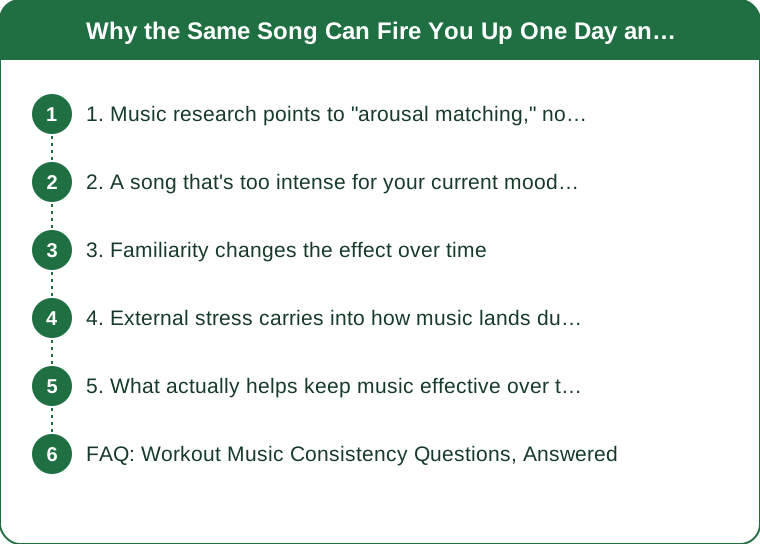
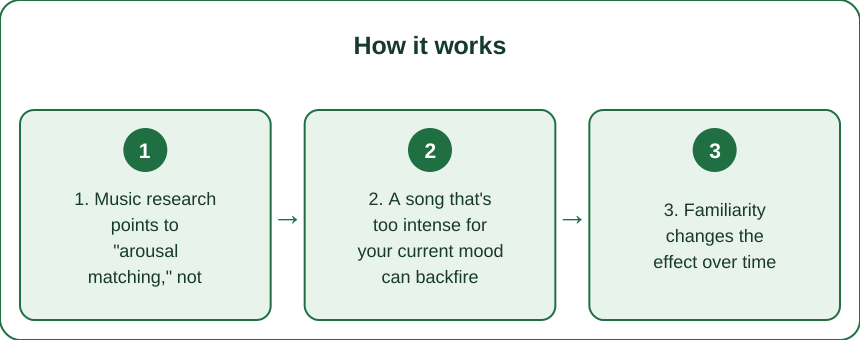
1. Music research points to “arousal matching,” not universal energy
Sport psychology research on music and exercise performance describes an “arousal matching” effect, where a song’s benefit depends on how well its energy matches your current physiological and emotional state, not just how objectively upbeat or high-tempo the track is.
2. A song that’s too intense for your current mood can backfire
If your baseline arousal is already low (tired, stressed, unmotivated), an extremely high-energy track can occasionally feel jarring rather than motivating, requiring a bigger mental jump than a moderately energizing song would to actually match and lift your state.
3. Familiarity changes the effect over time
Repeated exposure to the same song reduces its novelty-driven arousal boost over time, a well-documented pattern in music psychology — which is part of why a song that felt electric the first dozen times can gradually feel more neutral, unrelated to anything about your fitness or mood that day.

4. External stress carries into how music lands during a workout
Pre-workout stress or mental fatigue changes how the brain processes incoming stimuli, including music, meaning a rough day at work can make even a normally reliable playlist land differently than it does on a calmer day.
5. What actually helps keep music effective over time
Rotating playlists regularly offsets the fading novelty effect that makes familiar songs less energizing over time. Matching playlist energy to your actual starting mood, rather than always defaulting to maximum intensity, tends to produce more consistent motivation than a one-size-fits-all high-energy playlist.
FAQ: Workout Music Consistency Questions, Answered
Should I have different playlists for different moods, not just different workout types?
Yes — many people find mood-matched playlist options more consistently effective than a single “go-to” playlist used regardless of how they’re feeling walking in.
How often should a workout playlist be refreshed to avoid the familiarity fade?
There’s no universal number, but noticing when a previously reliable playlist starts feeling flat is a reasonable signal it’s time to rotate in new tracks.
Does this arousal-matching effect apply to podcasts or other audio too?
Some similar principles apply, though music’s tempo and rhythm-syncing effects on movement are more specifically studied than general audio content’s effect on exercise performance.
TL;DR:
- Music’s motivating effect depends on matching your current mood and arousal, not just the song’s energy level
- An intense song can occasionally feel mismatched rather than motivating when your starting state is already low
- Repeated exposure fades a song’s novelty-driven boost over time, unrelated to the workout itself
- Rotating playlists and matching energy to your actual mood produces more consistent motivation long-term
A flat reaction to a normally great workout song isn’t a playlist problem — it’s arousal matching, and rotating tracks plus mood-matching fixes the inconsistency better than forcing the same playlist every time.
Keep Reading
This article is for general informational and styling purposes only. Fit, sizing, and product availability may vary.