The Complete Guide to Earbuds That Stay In - Fit, Sweat, and Why Yours Fall Out
Quick Answer: Earbuds fall out for three reasons: the tip does not seal against your ear canal, the body of the bud is not braced against the ear, or sweat has broken the friction that was holding it. Each has a distinct fix, and tip size is the one people get wrong most often - including the ear-to-ear difference nobody checks. Test the seal, not the comfort. A bud that feels comfortable and loose will not survive twenty minutes.
Your earbuds are probably fine.
The tips are almost certainly the wrong size, and one of your ears is not the same as the other.

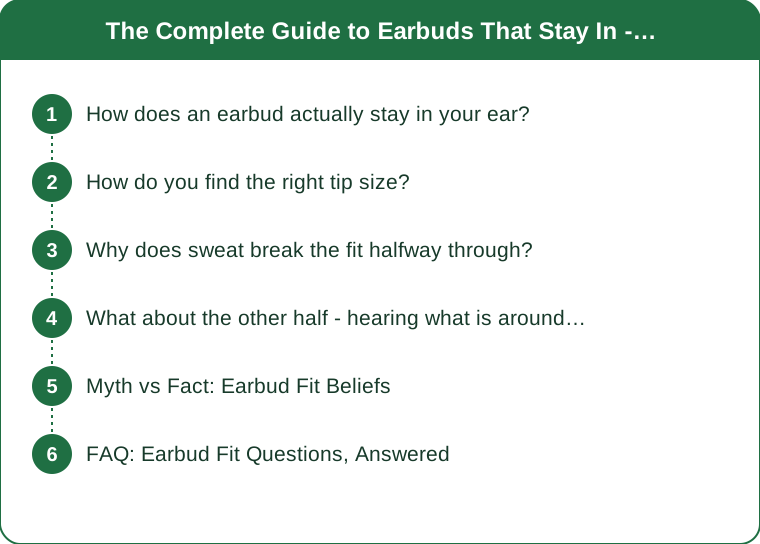
How does an earbud actually stay in your ear?
Through three separate mechanisms, and most people only ever adjust one.
The tip creates a friction seal against the ear canal. A correctly sized tip presses gently outward against the canal wall along its whole contact area, and that friction is the primary retention. Too small and it slides; too large and it sits proud without ever seating properly, which is the failure people misdiagnose as too small.
The body of the bud braces against the outer ear. The shell should make light contact with the ridges of your outer ear, which stops rotation and stops the bud levering out under movement. Rotation is the hidden failure mode - the bud twists a few degrees, the seal breaks, and it works loose over the next five minutes.
Wings, fins, or hooks add mechanical retention. These press against a fold of the outer ear or wrap over it, and they are the only mechanism that survives serious impact. For running and jumping, this is the difference-maker, and it is why sport-specific models exist rather than being a marketing distinction.
Weight and balance matter more than people credit. A heavier bud with its mass sitting outside the ear has more leverage working against the seal every time your head moves. Smaller and lighter genuinely stays in better at the same fit quality.
Cable or band tension can help or hurt. A neckband that tugs downward pulls buds out over time; a properly routed over-ear cable removes weight from the seal entirely. Cable routing is a free fix and the most commonly ignored one.
And your ear canals are not symmetrical. Ear canal size and shape differ between left and right in most people, sometimes substantially. Using the same tip size on both sides is the single most widespread fitting error, and it explains why so many people have exactly one bud that falls out.
All three mechanisms have to work together. A perfect tip in a bud that rotates will still fail, and a well-braced bud with an undersized tip will still slide. Diagnose which one is failing before buying anything.
How do you find the right tip size?
With two tests that take under a minute, and by ignoring how it feels at first.
Start with the seal test. Put the bud in, play something with bass, and cover the outside of the bud with a finger. A proper seal produces a noticeable increase in low frequencies and a sense of pressure; a poor seal sounds thin and open no matter what you do to the volume.
Then do the talk test. Speak a sentence out loud with the buds in. Your own voice should sound noticeably boomy and internal - that occlusion effect is the clearest sign of a genuine seal, and its absence is the clearest sign of failure.
Then the chew test. Open and close your jaw a few times, which changes the shape of your ear canal considerably. If the seal breaks when you chew, it will break when you run, because the same movement happens with every footstep.
Size each ear independently. Try a larger tip on the ear that fails and keep the working size on the other. Mixed sizes are normal and correct, and manufacturers include multiple sizes precisely for this.
Go one size larger than feels natural. People consistently choose tips that are too small because larger ones feel intrusive for the first minute. The correct tip feels slightly present and then disappears, which is not the same as feeling nothing at all.
Try foam tips if silicone will not hold. Memory foam compresses on insertion and expands to fill the canal, producing a seal that silicone often cannot match on irregular canals. They grip better when damp, which makes them the strongest option for sweat.
And insert with a twist. Pull the top of your ear gently up and back to straighten the canal, insert, then release and rotate the bud slightly to seat it. Most people just push straight in, which seats the tip at an angle and guarantees a partial seal.
Why does sweat break the fit halfway through?
Because the whole system depends on friction, and sweat is a lubricant.
Silicone loses grip when wet. The friction that holds a silicone tip against the canal wall drops sharply once a film of moisture forms between them. This is why buds survive fifteen minutes and fail at twenty - it is a moisture accumulation curve, not a wear-out.
Sweat production ramps up rather than starting immediately. You are dry for the first ten to fifteen minutes of most sessions, which is exactly why the fit seems fine at first and is not. Judging fit at the start of a workout is the fundamental testing error.
Foam tips behave better when damp. Foam maintains contact pressure through expansion rather than pure surface friction, so a film of moisture affects it less. For heavy sweaters, foam is the direct answer, and it costs a fraction of new earbuds.
Heat changes the ear canal itself. Your canal expands slightly as you warm up, which can loosen a tip that was correct at rest. Fitting when warm gives a more honest result than fitting cold.
Wings and hooks are unaffected by moisture. Mechanical retention does not depend on friction, which is why the buds that survive hard sessions almost always have some form of it. If your fit fails only when sweaty, this is the feature to buy.
Salt residue builds up over time. Dried sweat leaves residue on tips that changes the surface texture and can degrade grip across weeks. Rinse tips regularly in warm water and let them dry fully.
And hair products migrate. Anything on your skin or hair around the ear ends up on the bud and reduces friction further. Wipe around your ear before inserting if you use product - it sounds fussy and it works.

What about the other half - hearing what is around you?
Fit and awareness pull in opposite directions, and autumn makes this urgent.
A better seal means less awareness. The same seal that keeps the bud in also blocks external sound, which is a genuine safety consideration for outdoor training. You cannot fully separate these - a bud that lets you hear everything will not be sealed well.
Transparency modes are the modern compromise. Microphones pass external sound through, which restores a lot of awareness without breaking the seal. They are not perfect - they handle wind poorly and can compress the sound of approaching traffic.
Wind noise is the autumn problem. Transparency modes amplify wind directly into your ear, which gets unpleasant and drowns out everything useful. Switch it off in wind and rely on volume discipline instead.
Bone conduction is the awareness-first option. These sit outside the ear entirely, leaving the canal open, and they cannot fall out in the way in-ear buds do. Sound quality is a clear compromise and safety is a clear win.
Volume matters more than the seal for awareness. A well-sealed bud at low volume can leave you more aware than a loose one at high volume. Lower volume is the free safety intervention, and it also protects your hearing.
Darker evenings raise the stakes. As autumn shortens the days, more running happens in low light where you cannot see what you cannot hear. This is the season to reconsider the setup, not spring.
And one bud out is a legitimate strategy. Running with a single earbud on the traffic side removed is common, practical, and better than either extreme. It works with any hardware you already own.
Myth vs Fact: Earbud Fit Beliefs
Myth: if they fall out, they are the wrong earbuds. Fact: tip size, insertion technique, and cable routing account for the large majority of failures. Most people replace the hardware when the tips were the problem all along.
Myth: a tip that feels tight is too big. Fact: correct tips feel slightly present on insertion and then fade from awareness within a minute. The tip that feels perfect immediately is usually too small.
Myth: both ears take the same size. Fact: asymmetry between ears is extremely common, which is exactly why one bud falls out and the other never does. Mixed sizes are the correct answer, not a workaround.
Myth: expensive earbuds fit better. Fact: fit depends on the match between your ear geometry and the shell shape, which price does not determine. A cheap bud that suits your ears outperforms an expensive one that does not.
Myth: sweat resistance ratings tell you about fit. Fact: those ratings describe water ingress protection for the electronics, not retention. A fully waterproof bud can still fall out every four minutes.
Myth: noise cancelling helps them stay in. Fact: it is signal processing and has no effect on retention at all. It does reduce your awareness outdoors, which is a real consideration in the opposite direction.
Myth: you get used to a poor fit. Fact: you get used to adjusting them constantly, which is a different thing. Fixing the fit takes ten minutes and returns the attention you have been spending.
FAQ: Earbud Fit Questions, Answered
Why does only one earbud fall out?
Almost always because your two ear canals differ in size and you are using the same tip on both. Try one size up on the failing side - this fixes it for most people immediately.
Are foam tips worth it?
For anyone who sweats heavily, yes - they maintain contact better when damp and conform to irregular canals. They wear out faster than silicone and cost little to replace.
Should I use noise cancelling outdoors?
Generally not for running near traffic. Transparency mode or a single bud preserves the awareness that matters, and this becomes more important as evenings get darker.
How do I stop them slipping in cold weather?
Cold hands and a cold outer ear make insertion less precise, and hats and headbands push against the buds. Insert before putting a hat on, and check the seal afterwards.
TL;DR:
- Three mechanisms hold a bud in: tip seal, shell bracing, and wings or hooks. Diagnose which is failing.
- Use the seal test, talk test, and chew test - and size each ear independently, because ears differ.
- Sweat is a lubricant that breaks silicone friction around the twenty-minute mark. Foam tips fix this.
- Insert with a twist after pulling the ear up and back - straight-in insertion guarantees a partial seal.
- Awareness and seal are opposed - lower the volume, use transparency without wind, or run one bud out.
Before your next session, try one size larger on whichever ear keeps failing. It is free, it takes a minute, and it resolves the problem for most people.
Keep Reading
This article is for general informational and styling purposes only. Fit, sizing, and product availability may vary.