The Complete Science of Workout Music: Why It Works and How to Use It Right
Quick Answer: Music synchronized to movement tempo can improve endurance performance by measurable margins, primarily by reducing perceived effort (how hard the workout feels) rather than by changing your actual physiological capacity. The effect is strongest for steady, rhythmic activity like running or cycling, and weaker for max-effort strength work.
Workout music research goes back decades, and the findings are more specific and more interesting than ‘music helps you work out.’ Here’s the deep dive most fitness content skips.

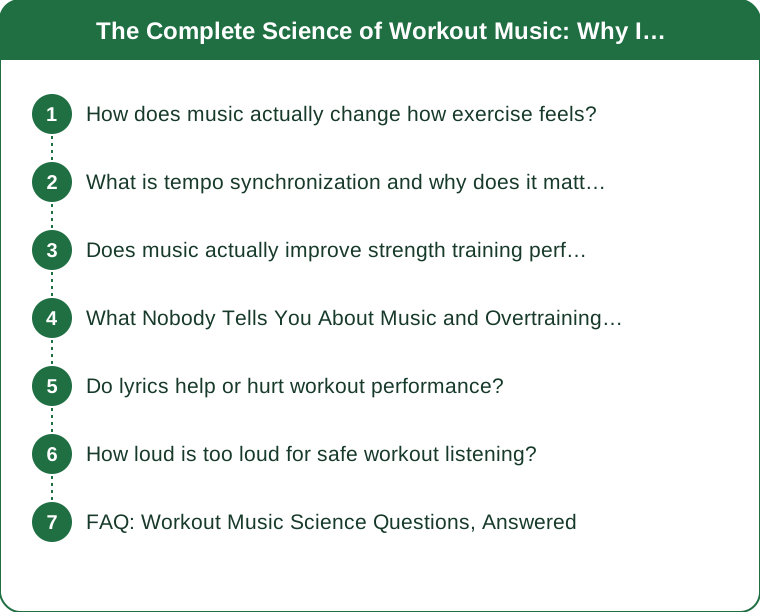
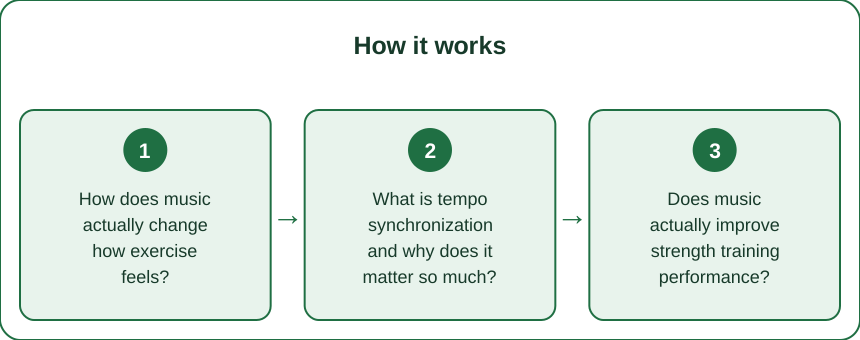
How does music actually change how exercise feels?
The core mechanism researchers point to is dissociation — music gives your attention something to focus on besides the discomfort signals your body is sending during exertion. Attention is limited, and every second spent processing a song’s rhythm and lyrics is a second not spent dwelling on burning quads.
Studies measuring rate of perceived exertion (RPE) during matched-intensity workouts with and without music consistently show the music condition rated as feeling meaningfully easier, even though heart rate and oxygen consumption were nearly identical between conditions. This means music isn’t making the workout physiologically easier — it’s changing your subjective read of the same objective effort, which matters enormously for whether you push through the final minutes of a hard session or bail early.
This dissociation effect is strongest at low-to-moderate intensity. At true maximal effort, the body’s internal signals become loud enough that music’s distraction effect weakens substantially — which is part of why elite marathoners in a final sprint often report barely noticing their music at all, even if they started the race locked into a playlist.
What is tempo synchronization and why does it matter so much?
Synchronization refers to matching your movement cadence — your running stride rate, your pedal cadence, your rep tempo — to the beats per minute (BPM) of the music playing. When these align, research shows measurable improvements in movement efficiency, sometimes described as reduced oxygen cost for the same output pace.
The mechanism appears to be partly neuromuscular: a steady external rhythm helps regulate motor unit firing patterns, effectively giving your nervous system a metronome to lock onto instead of having to self-generate and monitor pacing purely internally. This is measurably different from simply having upbeat music playing in the background without any tempo matching — asynchronous music still helps with mood and distraction, but synchronized music adds this additional efficiency layer on top.
Practically, this means a runner targeting an 170 steps-per-minute cadence benefits more from a curated 170 BPM playlist than from a generically ‘energetic’ playlist running at 128 BPM, even if both playlists feel similarly motivating on a subjective level. Several running apps now build entire features around this exact principle, adjusting track selection in real time to match detected cadence.
Does music actually improve strength training performance?
The evidence here is more mixed than for endurance work. For short, maximal-effort lifts (a single heavy deadlift, a 1-rep max attempt), music’s dissociation benefit matters less because the lift is over before fatigue-related discomfort has time to build meaningfully — there’s less unpleasant sensation for music to distract you from.
Where music shows clearer strength-training benefit is in higher-rep, fatiguing sets — think a 15-rep squat set or a metabolic conditioning circuit — where sustained discomfort builds over 30-60 seconds and dissociation has real work to do. Several studies on resistance training volume found participants completed measurably more total reps to failure with motivational music compared to silence, particularly in sets extending past 20-30 seconds of continuous effort.
There’s also a documented pre-performance arousal effect: listening to high-tempo, personally preferred music in the minutes immediately before a heavy lift is associated with small but measurable increases in force output, likely through general psychological arousal and confidence rather than any dissociation mechanism — this is a separate pathway from the in-set distraction effect.

What Nobody Tells You About Music and Overtraining Feedback
Here’s the part sports psychologists flag but rarely makes it into fitness content: because music reduces your perceived effort, it can also mute your body’s early fatigue warning signals — the same mechanism that helps you push through a tough interval can make it harder to notice you’re approaching genuine overreaching territory.
Athletes in heavy training blocks are sometimes advised to do at least some sessions without music specifically so they stay calibrated to their actual internal effort signals, rather than relying entirely on a subjective sense that’s being systematically dampened by their playlist. This doesn’t mean ditching music — it means treating occasional silent sessions as a genuine fatigue-monitoring tool, not a punishment.
Do lyrics help or hurt workout performance?
This depends heavily on the type of effort. For rhythmic, repetitive endurance activity, lyrical content seems to matter less than tempo and personal preference — a song you love with lyrics outperforms an instrumental track you’re neutral about.
For complex or skill-based training — technical lifts, coordination drills, learning new movement patterns — instrumental or lower-lyrical-density music tends to interfere less with the verbal/cognitive processing needed to focus on technique. Some research on motor skill acquisition specifically found lyrics competing for the same cognitive resources needed to process coaching cues or internal form checks, creating a small but measurable interference effect during the learning phase of a new movement — though this effect largely disappears once a movement pattern is well-learned and more automatic.
How loud is too loud for safe workout listening?
Hearing health research consistently flags 85 decibels as the threshold where prolonged exposure (over about 8 hours cumulative) starts posing risk, and most people’s workout listening volume, especially with earbuds in a noisy gym environment where you’re unconsciously raising volume to compete with ambient noise, sits well above safe limits without realizing it.
The practical rule several audiologists recommend: if you can’t hear a normal conversational voice from 3 feet away while your music plays, it’s too loud. Over-ear headphones that passively block gym noise let you listen at a lower, safer volume than earbuds competing directly against ambient sound — worth considering if workout music is a daily habit rather than an occasional one.
For outdoor runners specifically, volume creates a second risk layer beyond hearing health: situational awareness around traffic and other path users. Many running safety guidelines now recommend bone-conduction headphones or single-earbud use specifically for outdoor sessions, keeping one ear open to ambient environmental sound.
FAQ: Workout Music Science Questions, Answered
Does the genre of music matter, or just the tempo?
Tempo and personal preference both matter, but tempo is the more consistently studied variable — a disliked song at the right BPM still tends to outperform a beloved song at a mismatched tempo for pure synchronization benefit, though preference clearly matters for overall enjoyment and adherence.
Can music actually make you lift heavier weight, not just feel better?
Some studies show small measurable increases in force output and total volume with motivational music, particularly in fatiguing, higher-rep work — the effect exists, but it’s modest, not the huge multiplier fitness marketing sometimes implies.
Is it bad to always work out in silence if I prefer it?
Not at all — some athletes report better body awareness and pacing precision without music, and the performance research shows music helps on average, not universally; if silence lets you train consistently and safely, that’s the more important factor.
Does listening to the same playlist repeatedly reduce its effectiveness?
There’s some evidence for habituation reducing the motivational novelty effect over many repeated sessions with identical tracks — rotating in new music periodically while keeping a core of proven favorites tends to sustain the benefit longer than a completely static playlist.
TL;DR:
- Music reduces perceived effort more than it changes actual physiological capacity
- Tempo-synchronized music adds a measurable efficiency benefit beyond generic upbeat music
- Music helps most in fatiguing, higher-rep or endurance work — less in single max-effort lifts
- Occasional silent sessions help you stay calibrated to real fatigue signals
- Keep volume low enough to hear a conversational voice from 3 feet away
Workout music isn’t just a mood booster — it’s a genuine performance tool with real mechanisms behind it, as long as you’re using tempo and volume thoughtfully rather than just hitting shuffle.
Keep Reading
This article is for general informational and styling purposes only. Fit, sizing, and product availability may vary.