Music in Group Classes vs Solo Training: The Complete Guide
Quick Answer: In solo training, music works mainly as dissociation and self-regulation — you use it to control your own effort and attention. In a group class, music is doing something structurally different: it synchronizes a room, sets the pace externally, and carries social energy. That is why a solo playlist feels flat in a class and why class music often feels overwhelming alone. Understanding which job you need done makes both settings work better.
You have a playlist that has carried you through two years of solo runs. You put it on for a home version of your favorite class and it does nothing. Meanwhile the class track you loved on Tuesday sounds absurd in your kitchen on Thursday.
Neither is a taste problem. The music is doing a different job in each setting, and this guide goes through what those jobs are, how tempo and lyrics function differently in each, and how to build for both.
What music is actually doing in a solo workout
In solo training, music serves you individually, and the research on it points to several distinct mechanisms working at once.
Dissociation from effort. The most studied effect. Music draws attention away from internal sensations — breathing, burning, fatigue — and toward an external stimulus. This reliably reduces perceived exertion at submaximal intensities, often by a meaningful margin. Crucially, the effect is strongest at low to moderate intensity and diminishes as you approach maximal effort, where internal signals become impossible to ignore. This is why music helps a steady run enormously and helps a maximal sprint interval much less.
Arousal regulation. Music raises or lowers physiological and psychological arousal. You use it as a dial — something driving before a heavy set, something calmer for a recovery session. Solo training is where this control matters most, because there is nobody else setting the emotional tone of the room.
Pacing and rhythm. Tempo influences cadence. Runners and cyclists naturally drift toward synchrony with a strong beat, and a well-chosen BPM can hold a pace you would otherwise let slip. This is the most concrete, measurable benefit available in solo endurance work.
Motivation to start and continue. For many people the playlist is part of the ritual that gets the session started at all — an associative cue as much as an in-session tool.
Attentional strategy. Elite endurance athletes often deliberately associate rather than dissociate — attending closely to breathing and form. Music is a dissociation tool, which is excellent for most training and occasionally the wrong tool if your session’s purpose is to develop pacing feel or technique awareness. The practical implication: use music for the sessions where you want the work to feel easier, and consider going without for the sessions where you are trying to learn what a pace feels like.
The overall picture: in solo training, music is a personal regulator. You choose it, it modifies your experience, and the only person it has to work for is you.
What music is doing in a group class — a genuinely different job
In a class, several of music’s functions get taken over by the room, and new ones appear.
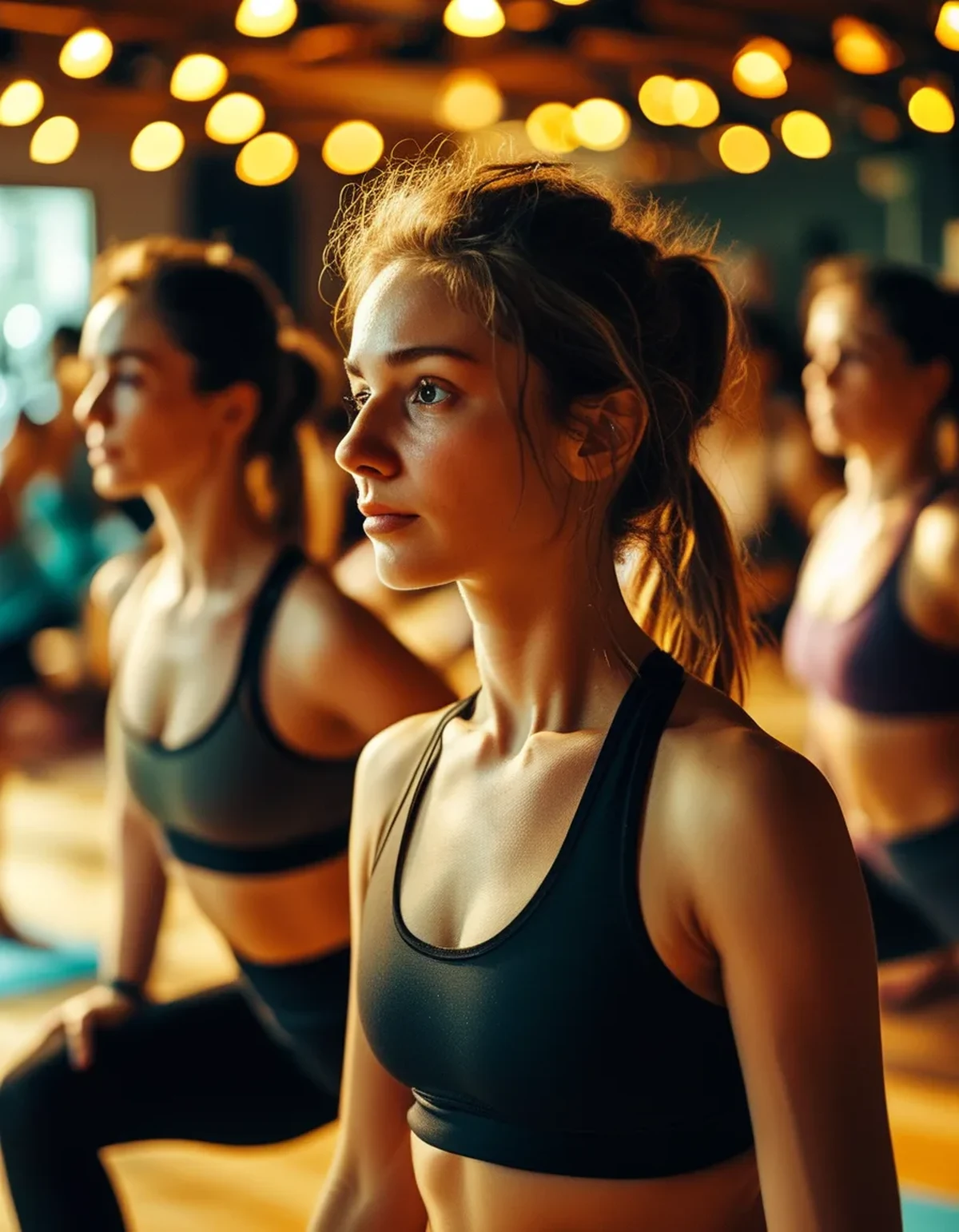
External pacing replaces self-pacing. The instructor and the track set the tempo; you follow. You are no longer using music to regulate yourself — you are using it to stay with everyone else. This is a fundamentally different relationship, and it is why class music can feel prescriptive when you are alone.
Synchrony and social bonding. There is a substantial body of research on synchronized movement to music increasing group cohesion and, in some studies, pain tolerance and perceived exertion effects beyond what the music alone produces. Moving in time with other people to a shared beat is doing real psychological work — it is one of the oldest things humans do together.
Structural signaling. In a well-programmed class, the music tells you what is coming: the build, the peak, the recovery. The track change is the instruction. Regulars learn the shape of a class through its music and anticipate effort accordingly, which is a genuine performance benefit.
Emotional permission. Loud, dense, high-energy music in a room full of people makes maximal effort socially normal. Alone, the same track has no room to fill and can feel theatrical.
Masking. Class music covers heavy breathing, equipment noise, and the self-consciousness of being watched. For newer participants this is a genuinely significant part of what makes a class tolerable — the music provides a kind of privacy inside a crowded room.
The trade-off: in a class you surrender control. The tempo will not match your preferred cadence, the volume may be above your comfort, and the genre is chosen for a room average rather than for you. For some people this is the whole appeal — the decision is made, you just follow. For others it is precisely why classes feel wrong, and that mismatch is worth naming rather than treating as a failure to enjoy something you should enjoy.
How tempo works differently in each setting
BPM matters in both, but for different reasons and with different constraints.
Solo: match tempo to your cadence, not to your intensity. The most useful application of BPM is synchronizing to movement rate. Running cadence for most people sits around 160 to 180 steps per minute, which means tracks in that BPM range, or half of it at 80 to 90 with a strong backbeat, encourage a naturally efficient rhythm. Cycling cadence is typically 80 to 100 rpm. The mistake is choosing very fast music for a slow effort — it creates a mismatch that feels agitating rather than motivating.
Solo: build a tempo arc across the session. A practical structure is warm-up 110 to 130 BPM, main work matched to cadence, intervals with fast tracks on and calmer tracks off, and a cool-down under 100. This gives you an external structure that supports the session’s shape rather than fighting it.
Group: tempo serves the choreography, not your cadence. In a class, the BPM is chosen so that the movement pattern lands on the beat for a room of people at a designed intensity. Different formats have well-established ranges — indoor cycling might sit anywhere from 60 to 130 depending on whether it is a climb or a sprint, and strength-based formats often use slower tempos so that reps land cleanly on the beat.
The practical implication for home versions of class formats: if you are doing a class-style workout alone, use class-style music rather than your solo playlist. The structure of a class track — long builds, clear drops, predictable eight-count phrasing — is what makes the choreography work. A solo playlist of songs you love has none of that architecture.
And the reverse: class tracks alone often feel oddly empty because they were built to be one layer of an experience that also included a room, an instructor, and other people. They are accompaniment, not the whole thing.

Lyrics, familiarity, and why the same song works differently
Two variables that behave almost oppositely across the two settings.
Lyrics in solo training: highly personal and often the main driver. Motivational lyrics that align with what you are doing — themes of effort, defiance, momentum — have measurable effects on motivation for many people. Solo training is where lyrical content matters most, because you are listening rather than following.
Lyrics in a group class: mostly irrelevant, sometimes a distraction. You are attending to an instructor’s voice, counting, and watching. Dense lyrical content competes with the instruction. This is why so much class music leans on repetitive vocal hooks and instrumental builds rather than narrative songs.
Familiarity in solo: mostly good, with a decay problem. Known tracks are more reliably motivating because you anticipate the peaks and can time effort to them. But familiarity decays — the same playlist loses its effect after enough repetitions, which is one of the most common complaints in workout music. The fix is rotation and reservation: keep two or three tracks exclusively for hard sessions and never listen to them casually. Their power persists far longer.
Familiarity in group: less important, because the instructor provides the anticipation. You do not need to know the track — you can see the build coming from the room. This is why classes tolerate new music far better than solo sessions do.
The volume difference is real too. Class volume is set high partly for energy and partly to unify a room, and prolonged exposure to loud music carries genuine hearing risk. Class volumes in some studios reach levels where duration matters. If a class routinely leaves your ears ringing, that is a signal — filtered musicians’ earplugs reduce volume without muffling clarity and are worth considering. This is general information, not medical advice.
And headphones in solo training carry the mirrored risk: the temptation to raise volume to overcome ambient noise. If you cannot hear traffic, the volume is a safety problem before it is a hearing one.
How to build a solo playlist that keeps working
A practical construction method, using the principles above.
Structure it in four phases rather than as one long shuffle.
Phase 1 — Arrival, 5 to 8 minutes, 100 to 125 BPM. The job here is transition, not intensity. Familiar, moderate, unchallenging. This phase is doing habit work: it signals that the session has begun.
Phase 2 — Build, 8 to 12 minutes, rising to your working tempo. Tracks that escalate. This is where you want the arc to feel like it is going somewhere.
Phase 3 — Work, the bulk of the session, matched to cadence or to interval structure. For steady work, choose consistent BPM tracks matched to your movement rate. For intervals, alternate — high-energy on, deliberately calmer off. The off track matters more than people think: a calm recovery track measurably helps heart rate come down and makes the next interval better.
Phase 4 — Cool-down, 5 minutes, under 100 BPM. Almost everybody skips this and it is genuinely useful — it supports the transition out of training and reinforces that the session has a shape with an end.
Maintenance rules that keep it working:
Rotate 20 to 30 percent monthly. Not the whole thing — the anchors should stay.
Reserve two or three tracks for hard sessions only. Never in the car, never doing dishes. This is the single most effective technique for preserving a track’s motivational power.
Keep a separate short playlist for the sessions where you deliberately want no dissociation — technique work, pacing practice — or simply train those without music.
Build a class-style playlist separately if you do home versions of class formats, with the long builds and clear phrasing those formats need.
What Nobody Tells You About Music and Training
The music that works best is often not the music you like most. Motivational effect depends on rhythm response, tempo match, and associations — none of which track neatly with taste. A track you find slightly embarrassing may outperform your favorite album for a threshold interval, and the sooner you accept that, the better your playlist gets.
The effect fades fastest for the tracks you love most, because you listen to them elsewhere. Protection is the whole strategy.
Silence is a legitimate training tool. Athletes who train exclusively with music often discover that race day, class day, or a competitive setting sounds nothing like their training. Doing some sessions without music builds tolerance for your own breathing and internal chatter, and improves your ability to pace by feel. One in every four or five sessions without headphones is a reasonable practice.
Group class music is not designed for you specifically, and that is the point. Complaining that it is too loud, too repetitive, or not your genre is often a mismatch of expectations — you are receiving a shared experience, not a personalized one. If you consistently want personalized, the honest answer is that solo training suits you better, and that is not a lesser choice.
Podcasts are a different tool entirely. They dissociate more strongly than music but provide no rhythmic entrainment and no arousal control. Excellent for long easy sessions, poor for anything requiring pace or intensity.
And the effect on performance is real but modest. Music makes work feel easier and sessions more enjoyable, which improves adherence — and adherence is by far the largest performance variable most people have access to. The playlist matters mostly because it gets you out the door.
FAQ: Workout Music Questions, Answered
Why does my favorite playlist stop working after a few months?
Habituation. The motivational effect of a track depends partly on novelty and partly on the anticipation of familiar peaks, and repeated exposure erodes the first while the second plateaus. Rotate 20 to 30 percent monthly, keep a few reserved tracks exclusively for hard sessions, and stop listening to your training music casually. The reserved-track approach extends useful life dramatically.
Should I use music for heavy lifting?
It depends on what you need. Music’s dissociation benefit is smallest at maximal intensity, but arousal regulation still matters for a heavy single, and many lifters use a specific track deliberately as a psych-up cue. The argument against is attentional — heavy lifting demands technique focus, and heavily dissociative listening can pull attention away from bracing and bar path. Many experienced lifters use music between sets and less attention on it during.
Is class music too loud, and what can I do about it?
Some studios do run at levels where duration becomes a genuine consideration. If you leave a class with muffled hearing or ringing, that is a warning sign, not a sign of a good class. Standing further from the speakers helps, and filtered earplugs designed for music reduce volume evenly without making everything sound muddy — many regular class-goers use them. Raise it with the instructor; it is a common and reasonable request. This is general information, not medical advice.
TL;DR:
- Solo music is a personal regulator: dissociation from effort, arousal control, and cadence pacing.
- Class music does a structural job — it synchronizes a room, sets pace externally, signals the workout’s shape, and carries social energy.
- Match BPM to your movement cadence in solo work, not to your intended intensity; class BPM serves the choreography instead.
- Lyrics matter most solo and compete with instruction in class; familiarity matters most solo and least in class.
- Build solo playlists in four phases, rotate 20 to 30 percent monthly, and reserve two or three tracks for hard sessions only.
- Train without music occasionally — it builds pacing feel and prepares you for settings that sound nothing like your headphones.
The reason it is worth separating these two jobs is that it stops you from judging one setting by the other’s standard. A class playlist is not trying to be your personal soundtrack, and your personal soundtrack was never built to synchronize twenty people through a burpee sequence. Once you know which job you need done, choosing what to press play on gets considerably easier.
Keep Reading
This article is for general informational and styling purposes only. Fit, sizing, and product availability may vary.