The Complete Guide to Why Your Outdoor Playlist Falls Flat in the Gym
Quick Answer: A gym floor runs 70 to 85 decibels of broadband noise, concentrated in the low and low-mid frequencies. That noise masks exactly the bass and kick-drum range that drives perceived intensity in most workout music, so the track arrives thinner and less motivating even at the same volume. Outdoors, ambient noise is lower and differently distributed, so the same mix lands fully. The fixes are better isolation, a gym-specific playlist weighted toward mid-range energy and vocals, and modest EQ - not more volume.
The playlist was perfect on the towpath in June. It is the reason you got through the last two miles.
In the weights room it sounds like someone playing it in the next building.
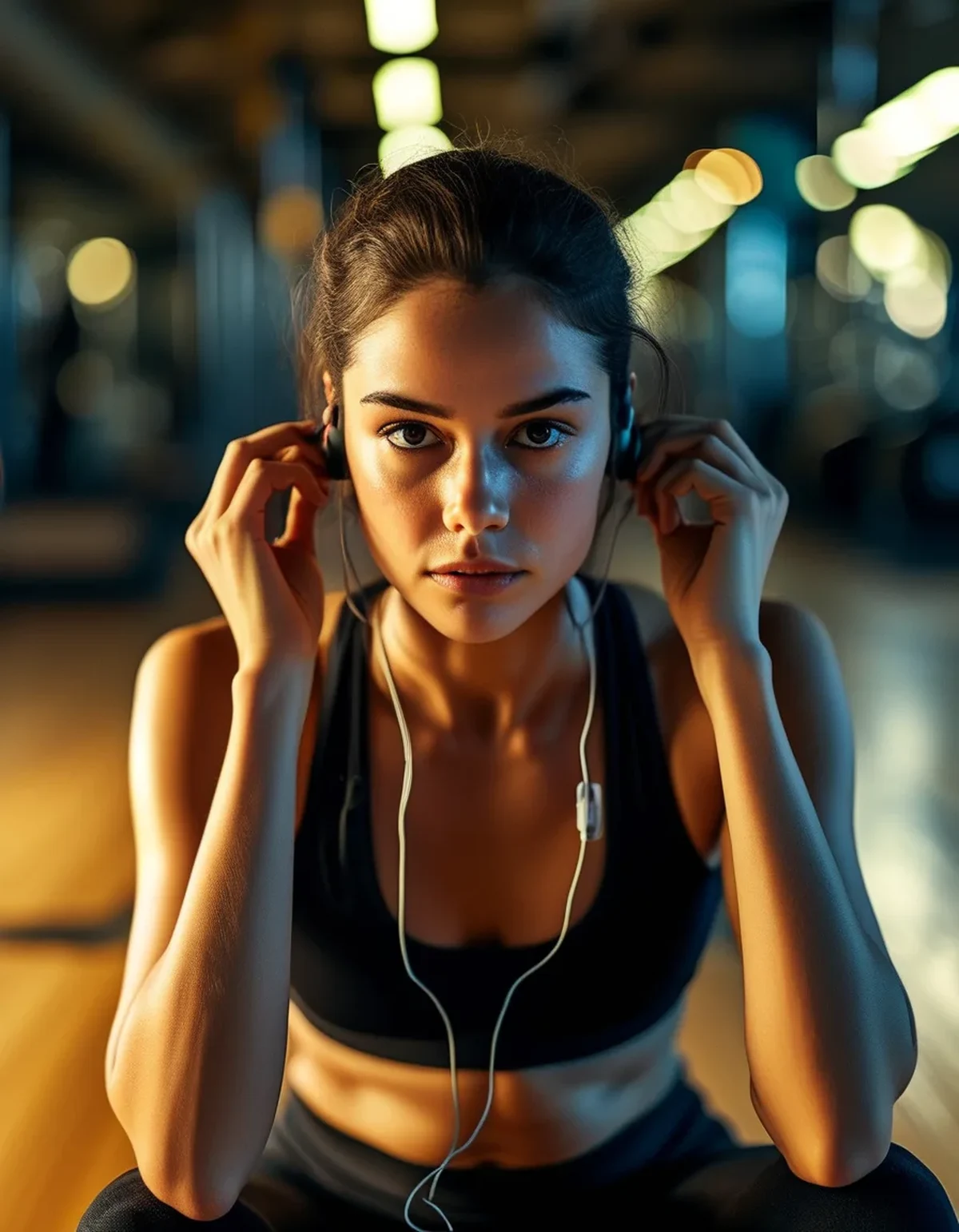
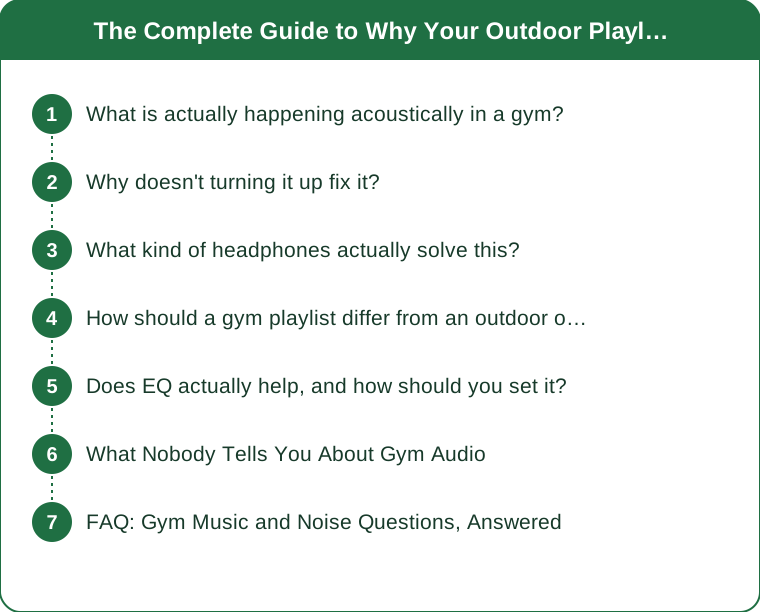
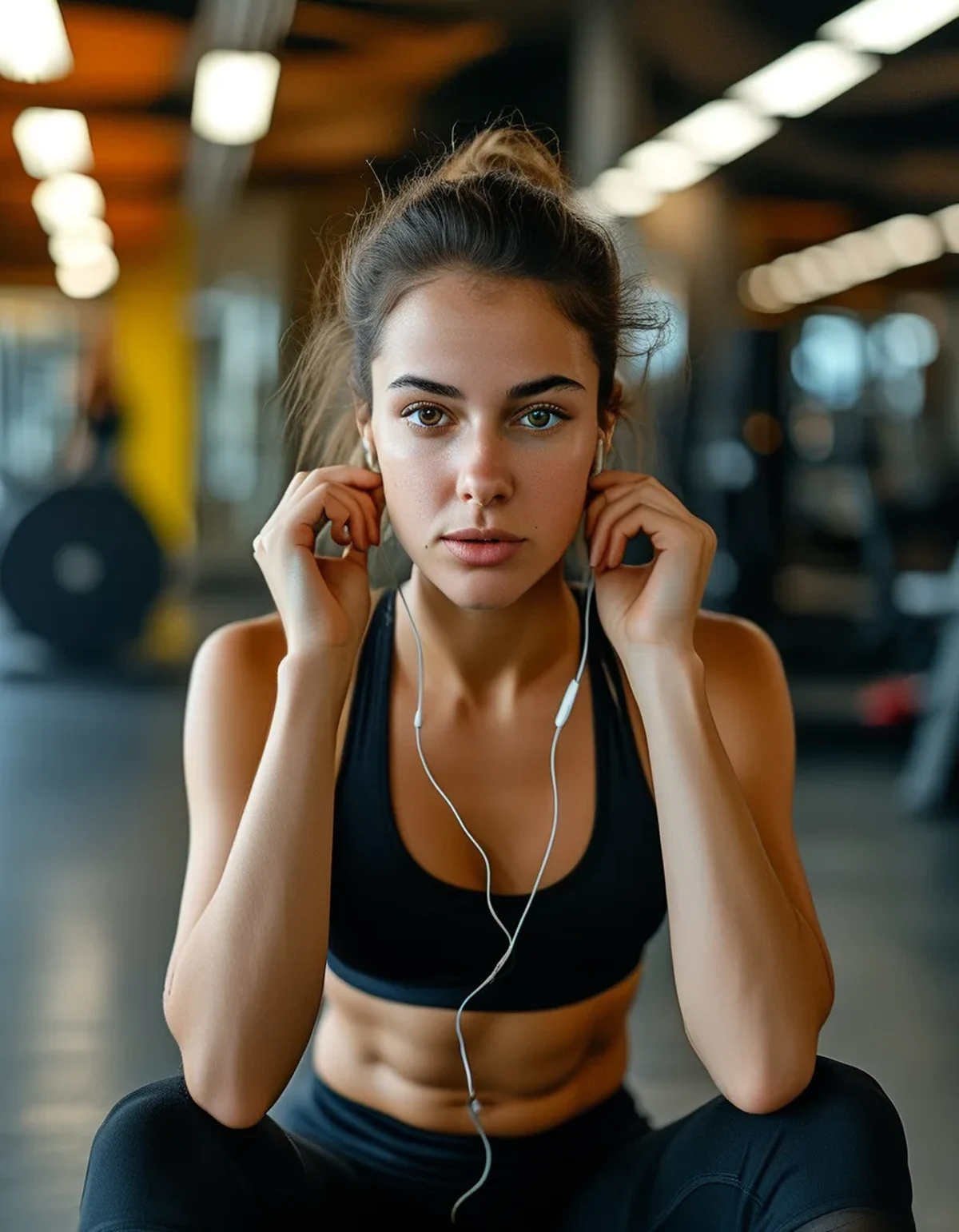
What is actually happening acoustically in a gym?
Auditory masking is the mechanism. When two sounds occupy the same frequency band, the louder one makes the quieter one partly or wholly inaudible - and gym noise is louder than you think.
Gym ambient noise sits between roughly 70 and 85 decibels on a busy floor, and it is not evenly spread. Plate clatter, dropped dumbbells, treadmill motors, ventilation and the building’s own class music concentrate energy in the low and low-mid range.
That range is where workout music does its emotional work. Kick drum fundamentals sit around 50 to 100Hz, bass lines from 60 to 250Hz, and the perceived punch of a track lives largely in that same window.
So the gym is not making your music quieter overall - it is making it quieter in one specific band, and it is the band the track was built around.
Outdoors the picture is different. Ambient noise on a park path is often 45 to 60 decibels, and traffic noise, while low-frequency, is intermittent rather than continuous. There are quiet gaps, and hearing works well in gaps.
Reverberation compounds it indoors. Gyms are large rooms full of hard surfaces - mirrors, rubber flooring over concrete, metal racks - and long reverberation times smear sound over time, which reduces clarity independently of level.
Your own body adds a layer. Under heavy load, breathing gets loud, heart rate is audible in the ears, and jaw and neck tension changes how earbuds seat, all of which alter what actually reaches the eardrum.
And the psychological piece is real. Attention in a gym is divided between the music, the set count, the mirror and the person waiting for your bench. Divided attention reduces how much of a track you actually process, which is why the same song can feel powerful outdoors and like background indoors.
Why doesn’t turning it up fix it?
Because masking is a ratio, not an absolute. To restore the same subjective balance, the music has to exceed the ambient noise in the masked band, and matching an 80 decibel room means driving the music well above it.
That puts you in genuinely risky territory. Sustained exposure above 85 decibels carries hearing risk, and the risk accumulates over hours - a 45-minute session several times a week adds up over years in a way single sessions never feel like they do.
Loud does not restore the shape of the track either. Raising overall volume raises everything, including the frequencies that were never masked, so you get a louder version of the same imbalance rather than a corrected one.
Equal-loudness effects work against you at the wrong end. Human hearing is less sensitive to low frequencies at low listening levels and more sensitive as level rises, which is part of why people keep reaching for the volume when the bass feels absent.
Distortion arrives before satisfaction does. Small drivers pushed hard to reproduce bass at high level distort, and distorted bass reads as harsh rather than powerful.
Volume also removes your situational awareness, which matters more in a gym than most people credit - not hearing someone behind you at the rack, or not hearing a plate slide, is a practical hazard.
And your ears adapt within minutes, so the level that felt right at the start feels insufficient by set four, which is exactly the ratchet that gets people to unsafe levels without noticing.
The correct lever is isolation, not amplification. Reducing how much ambient noise reaches your ear does the same job as raising the volume, without any of the above.
What kind of headphones actually solve this?
Passive isolation is the foundation, and it is underrated. A well-sealed in-ear tip blocks 20 to 30 decibels across a wide band purely mechanically, which does more for gym listening than any processing.
Tip fit is the whole game with in-ears. A tip that seals gives you full bass; a tip that leaks loses low frequencies first and dramatically. Most people who think their earbuds lack bass have a seal problem, not a driver problem.
Sweat breaks the seal progressively, which is why the sound thins out as the session goes on. Foam tips grip better when damp than silicone; some people carry a spare set for the second half of a session.
Active noise cancellation works best on exactly the frequencies gyms are worst for - continuous low-frequency noise like ventilation and treadmill motors. It handles that well.
But ANC handles impulsive noise poorly. A dropped dumbbell is a sudden broadband transient, and cancellation cannot predict it. So ANC helps with the hum and not with the clatter.
Over-ear closed-back headphones isolate best of all and are genuinely the best-sounding option on a gym floor, at the cost of heat, sweat and bulk. Plenty of people accept that trade for lifting and switch to buds for cardio.
Bone conduction is the wrong tool here. It is excellent for outdoor awareness and poor in noisy environments, because it deliberately leaves your ear canal open to the room.
And fit stability matters as much as sound. An earbud you adjust every set interrupts the listening more than the ambient noise does, so ear hooks or wing tips are worth having for anything with impact.
How should a gym playlist differ from an outdoor one?
Weight it toward mid-range energy rather than sub-bass. Tracks whose drive comes from guitars, synth leads, snare and vocals survive masking far better than tracks built on a deep low end.
Prioritise vocals. The human voice sits in the 300Hz to 3kHz range, which is where gym noise is comparatively weakest and where hearing is most sensitive. Vocal-forward tracks cut through when instrumental bass-driven ones do not.
Choose denser production over sparse. Sparse, spacious mixes rely on silence for impact, and there is no silence on a gym floor. Busy, compressed mixes hold their shape in noise.
Compression is your friend here, unusually. Heavily compressed masters have a small dynamic range, which means quiet passages do not disappear entirely into the room. Audiophile advice runs the other way; gym advice does not.
Match tempo to the work, not to the room. 130 to 150 BPM suits steady cardio, 100 to 130 suits lifting where you want drive without rushing your tempo, and heavy singles are often better with something slower and heavier than fast.
Keep a separate outdoor list. The spacious, bass-led, dynamic tracks that fall flat indoors are exactly the ones that shine on a quiet morning run, so this is a two-playlist problem rather than a compromise problem.
Order matters more indoors. Because attention is divided, the transitions you would notice outdoors go unnoticed in the gym, so front-load the strongest tracks into the working sets rather than saving them.
And test the list on the floor, not at home. A playlist auditioned on a sofa is auditioned in the wrong acoustic environment, which is how most gym playlists end up wrong in the first place.
Does EQ actually help, and how should you set it?
Yes, and more than most people expect, because you are correcting a known and fairly predictable frequency imbalance rather than guessing.
A modest low-shelf boost of 3 to 5 decibels below about 150Hz compensates for the most heavily masked band without pushing drivers into distortion.
Avoid large bass boosts. Above roughly 6 decibels you are asking small drivers for excursion they do not have, and the result is muddiness rather than power.
A small presence lift around 2 to 4kHz improves vocal and snare clarity, which is where the intelligibility that survives masking actually lives.
Cut rather than boost when you can. Reducing the low-mid around 300 to 500Hz, where gym noise and music mud overlap, often does more for clarity than any boost.
Use the app EQ rather than the headphone EQ when both exist, since doubling up leads to clipping that you hear as distortion on the loudest passages.
Save it as a gym preset and switch back for outdoors, because the same EQ that rescues a track indoors makes it boomy on a quiet path.
Check it on your worst track, not your best. A preset tuned on a well-produced favourite tends to fall apart on the thinner tracks that need the help most.
And re-check it after any tip change, because a different seal changes the low-frequency response more than any EQ setting you will make.
What Nobody Tells You About Gym Audio
The gym’s own music is fighting yours, and it usually wins the low end. Most facilities run a house system with substantial bass through large speakers, and that is a continuous, high-energy source in exactly the band your headphones are trying to reproduce. This is the single biggest reason a playlist that works at a quiet 6am session falls apart at 6pm in the same room. If your gym has quiet hours, your playlist will genuinely sound better in them - it is not just that you feel better.
Where you stand changes what you hear. Rooms have standing waves, and low frequencies build up near walls and corners and cancel in specific spots. A rack against the back wall and a rack in the middle of the floor are meaningfully different listening environments. People develop preferences for particular corners of the gym without ever knowing that acoustics are part of the reason.
Your heart rate changes your hearing. At high exertion, blood flow noise is audible in the ears and effectively raises your personal noise floor from the inside. This is why music feels most present during rest intervals and thinnest during the hardest part of a set - precisely backwards from when you wanted it.
Jaw tension moves your earbuds. Clenching during a heavy set changes the shape of the ear canal enough to break a marginal seal, which is why bass sometimes disappears exactly at the rep where you most wanted it. A tip one size larger than you think you need usually survives clenching.
One earbud out is a real strategy, not a compromise. Plenty of experienced lifters run one bud for heavy sets - it maintains awareness of the room and the bar, and the loss of stereo matters far less than the loss of situational awareness would. It also halves the seal problem while you are sweating.
Hearing damage from gym audio is genuinely cumulative and genuinely underestimated. Nobody notices it in a session. The people who notice it are in their forties wondering why they need subtitles. Phone operating systems now report weekly headphone exposure, and checking that number once is worth more than any amount of general advice about volume.
And silence is a legitimate option for heavy work. A significant number of strong lifters train the heaviest sets with nothing on, using music only for warm-ups, accessories and cardio. The argument is attentional rather than acoustic: for a maximal effort, the internal cues matter more than the external drive. It is worth trying for a block before assuming you need the playlist fixed at all.
FAQ: Gym Music and Noise Questions, Answered
What volume is actually safe in a gym?
Aim to stay under 85 decibels averaged over the session. Most phones now show weekly headphone exposure in the health or settings app, which is far more useful than trying to judge by feel.
Are noise-cancelling earbuds worth it for lifting?
For ventilation hum and treadmill noise, yes. For dropped weights and plate clatter, no - those are impulsive and cancellation does not catch them. Passive seal helps with both.
Why does my bass disappear halfway through a session?
Almost always a seal broken by sweat. Foam tips, a size larger, or wing tips that hold position through movement all fix it more reliably than any setting change.
Should I use the same playlist for cardio and weights?
Usually not. Cardio suits sustained tempo in the 130 to 150 BPM range; lifting suits track structure that lines up with sets and rests. Splitting them is a quick improvement.
Does the gym’s house music affect my headphones?
Yes, substantially. It is a continuous high-energy low-frequency source that masks exactly the range your headphones struggle to deliver. Quieter hours genuinely sound better.
Is one earbud in safer than two?
For awareness on a busy floor, clearly yes. It also tends to lower total exposure, since people run a single bud at a lower level than they run a pair.
Why does music feel less motivating during the hardest set?
Internal noise from breathing and blood flow rises with exertion, and your attention narrows onto the effort. Both reduce how much of the track you actually process at the moment you wanted it most.
TL;DR:
- Gym noise runs 70 to 85 decibels and concentrates in the low frequencies, masking exactly the bass and kick range that drives most workout music.
- Turning it up does not restore the balance and pushes you toward genuine hearing risk.
- Isolation is the real fix: a proper tip seal first, then ANC for continuous hum, or closed-back over-ears for lifting.
- Build a separate gym playlist weighted toward vocals, mid-range energy and dense, compressed production.
- A modest low-shelf boost under 150Hz plus a small presence lift around 2 to 4kHz corrects most of it - saved as a gym-only preset.
- Check your phone’s weekly headphone exposure number once, and consider training the heaviest sets with nothing on.
The playlist was never the problem. The room was eating half of it.
Keep Reading
This article is for general informational and styling purposes only. Fit, sizing, and product availability may vary.