How to Structure a Workout Playlist by Training Phase, Not Just Vibe
Quick Answer: An effective workout playlist matches tempo to training phase — lower BPM for warmup, your highest BPM tracks during peak-effort intervals, and a deliberate wind-down in tempo for cooldown — rather than random shuffle, which research on exercise-music synchronization consistently shows improves both perceived effort and actual output.
Most people build playlists around vibe or favorite songs, then wonder why the energy doesn’t match the workout. Structuring by training phase, not just mood, changes that.

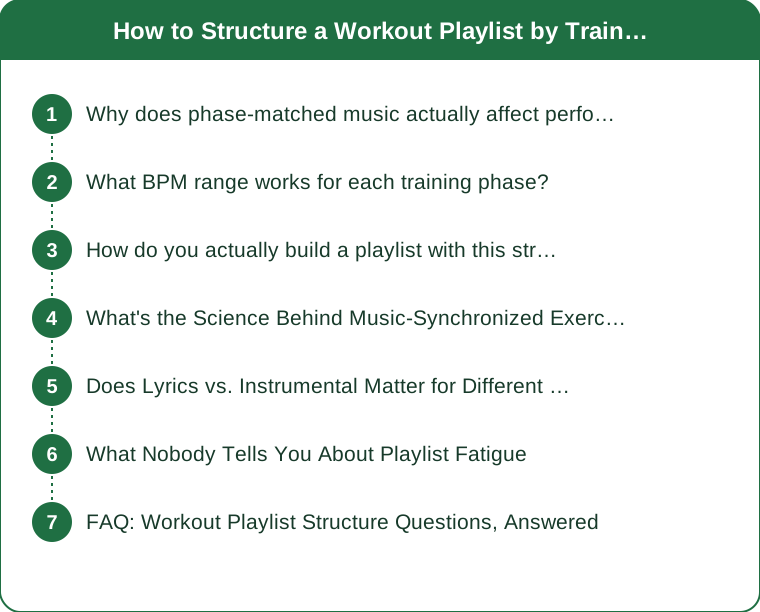
Why does phase-matched music actually affect performance?
Music tempo has a documented effect on movement rhythm and perceived exertion — faster BPM during high-intensity intervals can measurably reduce how hard an effort feels, which is why elite athletes and coaches take playlist structure seriously rather than treating it as background noise.
What BPM range works for each training phase?
Warmup: 100-120 BPM — enough to build energy without rushing your body before it’s ready. Peak effort intervals: 140-170+ BPM depending on the specific activity — this is where tempo-matched music shows the clearest performance benefit. Steady-state cardio: 120-140 BPM, matched loosely to your target pace. Cooldown: under 100 BPM, deliberately slowing to help bring heart rate and mental state down.
How do you actually build a playlist with this structure?
Most music apps let you search or filter by BPM directly, or you can use dedicated workout playlist tools that sort by tempo. Build 4 separate short playlists (or clearly ordered sections) — one per phase — rather than one long shuffled list, so the tempo transition happens deliberately rather than randomly.

What’s the Science Behind Music-Synchronized Exercise?
Research on this specifically (sometimes called ‘entrainment’) shows that syncing movement rhythm to music tempo can improve endurance and reduce perceived effort by a meaningful margin compared to unsynchronized or no music. The effect is strongest in cyclical, repetitive movement — running, cycling, rowing — where a consistent tempo naturally lines up with stride or stroke rate.
This doesn’t mean every song needs to perfectly match your cadence, but staying within a phase-appropriate BPM range captures most of the benefit without needing precise beat-matching.
Does Lyrics vs. Instrumental Matter for Different Phases?
For peak-effort intervals, lyrics with motivational or high-energy themes tend to outperform instrumental tracks for perceived motivation, based on most self-reported studies. For cooldown and lower-intensity warmup, instrumental or calmer vocal tracks tend to support the intended mental state better, since aggressive lyrics can work against a wind-down.
What Nobody Tells You About Playlist Fatigue
The exact same playlist, reused for months, gradually loses its performance benefit as familiarity reduces the music’s arousal effect — this is a well-documented pattern. Refreshing at least a third of your peak-effort tracks every few weeks maintains more of the psychological boost than sticking with one ‘perfect’ unchanging list.
FAQ: Workout Playlist Structure Questions, Answered
Do I need exact BPM matching or is ‘roughly in range’ good enough?
Roughly in range captures most of the benefit for casual training — precise beat-matching to your exact cadence is more relevant for competitive or highly structured training.
How often should I update my workout playlist?
Refreshing at least a portion of your high-intensity tracks every 3-4 weeks helps counter the familiarity effect that reduces music’s motivational impact over time.
Does this structure work for strength training too, or just cardio?
It applies less precisely to strength training since there’s no continuous movement cadence to sync to, but higher-BPM music during working sets and lower-BPM during rest periods still shows a general motivational benefit.
TL;DR:
- Match music tempo to training phase: lower BPM for warmup/cooldown, higher for peak effort
- Peak effort: 140-170+ BPM; steady-state: 120-140 BPM; cooldown: under 100 BPM
- Motivational lyrics help most during high-intensity intervals; instrumental suits cooldown better
- Refresh at least a third of your playlist every few weeks — familiarity dulls the performance benefit
Keep Reading
This article is for general informational and styling purposes only. Fit, sizing, and product availability may vary.