Speakers vs Headphones in a Home Gym: The Complete Guide
Quick Answer: Speakers win for lifting — no cable snag, no earbud shifting under a barbell, and you keep the environmental awareness that matters when there is weight overhead. Headphones win for cardio and focus work, where isolation raises immersion and lowers perceived effort. The deciding factors in a home gym are usually household noise, hearing safety at volume, and whether a dropped earbud can end your set.
Same music. Same session.
One setup makes you feel like you are in a gym. The other makes you feel like you are inside the song.
Both are useful. They are just useful for different things.
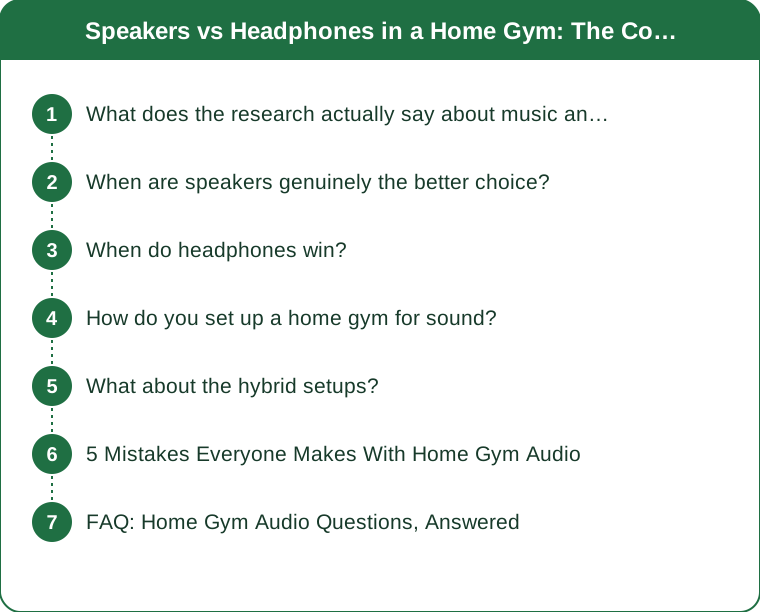
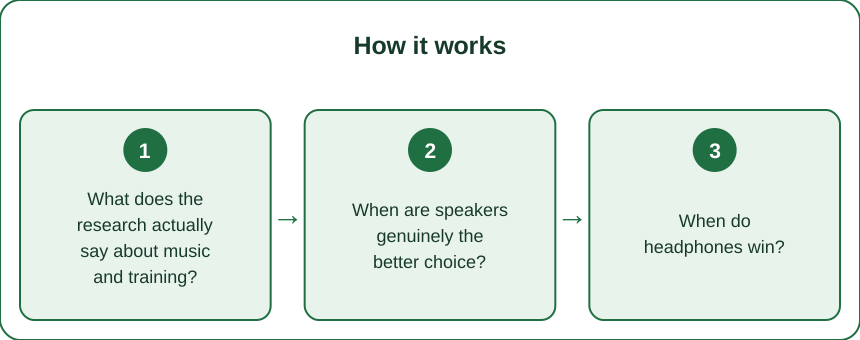
What does the research actually say about music and training?
Enough to make the choice worth thinking about, and less than the headline claims suggest.
Music reliably reduces perceived exertion at submaximal intensities. This is one of the more robust findings in the area: the same effort feels easier with music, particularly during steady-state work. The effect is largest at low to moderate intensity and shrinks as intensity climbs toward maximal, where physiological signals dominate attention and there is little spare capacity for anything else.
Tempo matters, within a range. Faster music is generally associated with higher self-selected work rates during cardio, with most of the useful range falling around 120-140 BPM for moderate work and higher for intervals. Beyond roughly 140-150 BPM the additional benefit flattens out for most people.
Music can improve performance in endurance and repetitive tasks more consistently than in maximal strength efforts. For a one-rep max, your attention is entirely internal; for a 40-minute steady ride, external focus is a genuine asset.
And the mechanism is largely attentional. Music works partly by shifting attention outward, away from breathing, burning and discomfort — what the literature calls dissociation. That is precisely why the delivery method matters: isolation increases dissociation, and awareness decreases it. Headphones push you inward into the music and away from the room. Speakers keep you in the room, with music in it.
That single distinction explains almost every practical recommendation that follows.
When are speakers genuinely the better choice?
Five situations, and the safety one is not negotiable.
Any lifting with weight overhead or on your back. Squats, presses, cleans, bench with heavy dumbbells. You want to hear the bar, the plates, the rack, and anyone entering the room. Environmental awareness is a safety feature when the weight can land on you, and noise-cancelling headphones remove it deliberately.
Anything where an earbud can fall out mid-set. Sweat plus impact plus a barbell path near your ears is a bad combination. A dropped earbud mid-set is a distraction at best and a failed rep at worst.
Sessions where you coach yourself out loud. Counting reps, cueing yourself, breathing rhythmically. Hearing your own voice normally — rather than through the occlusion effect of a sealed earbud — is genuinely easier.
Shared sessions. Training with a partner or family member means shared audio, and speakers are the only version of that which works.
And long sessions. No battery anxiety, no ear fatigue, nothing pressing on your ears for ninety minutes. Speakers are simply more comfortable over time.
The speaker trade-offs are real too. Room acoustics in a garage or spare room are usually poor — hard parallel surfaces, bass buildup in corners, and a lot of reflection. Placing the speaker off the floor, away from a corner, and roughly at ear height improves it far more than buying a better speaker does.
When do headphones win?
Five scenarios, and the first two are the common ones.
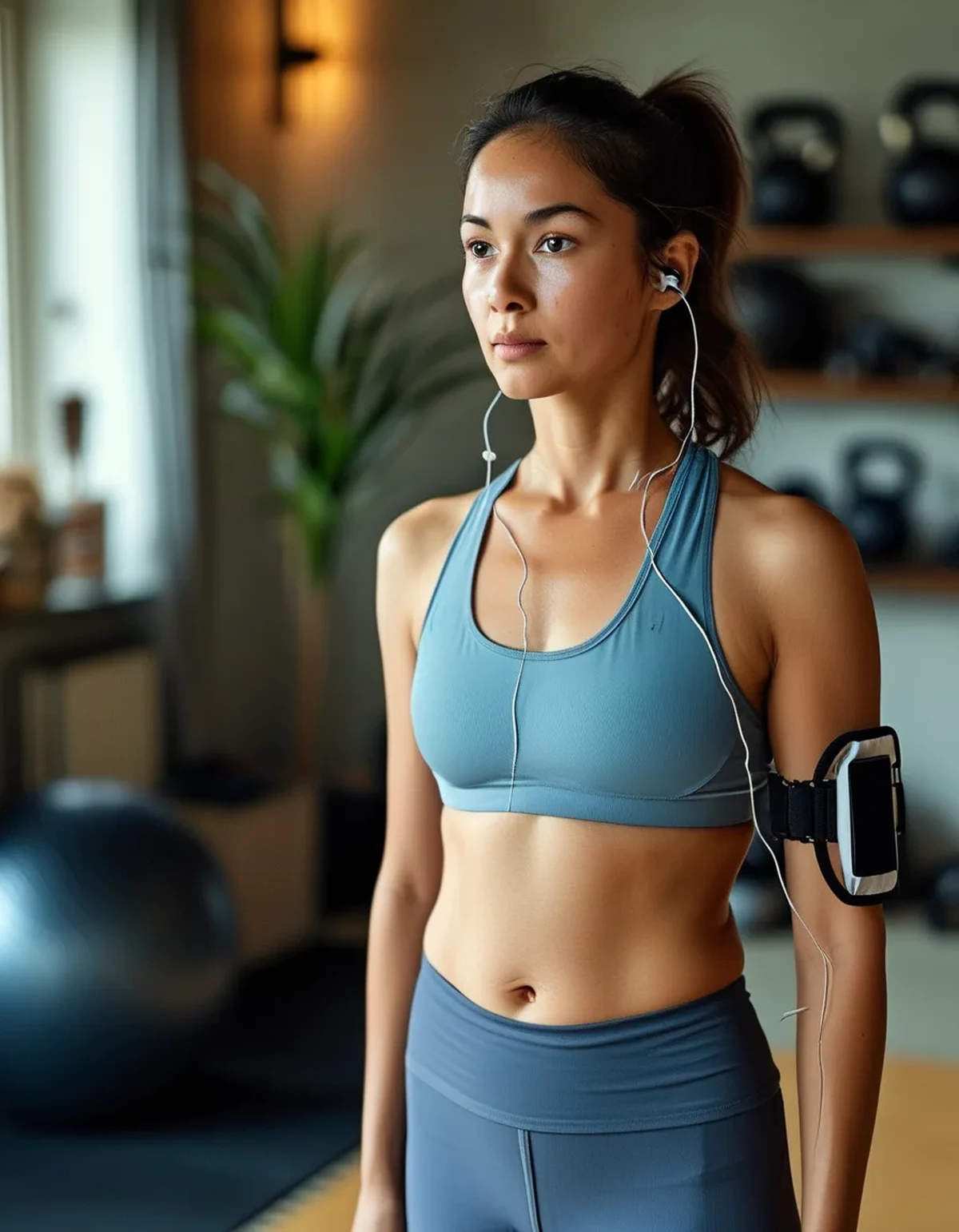
Steady-state cardio. This is where the perceived-exertion benefit is largest and where dissociation is most useful. There is no safety argument against isolation on a stationary bike in your own spare room, and the immersion genuinely makes a 45-minute ride shorter.
Early mornings and late evenings in a shared home. The practical reason most home gym audio ends up in headphones. Nobody wants your interval playlist at 5:40am, and a home gym habit that annoys the household is a home gym habit that ends.
Focused technical work. Skill practice, mobility, anything where you want to be internal and undistracted by household noise.
When the room sounds bad. A concrete garage with a metal door makes almost any speaker sound poor. Headphones bypass the room entirely, which is sometimes the honest answer.
And when you need the volume down. This is the part people get backwards: headphones let you listen at a lower absolute level and still hear detail, because you are not fighting room noise and reflections. The problem is that most people use that headroom to go louder, not quieter.
Hearing safety, concretely. Prolonged exposure at around 85dB carries risk, and risk rises steeply as level increases — each few decibels roughly halves the safe exposure time. Many earbuds reach well beyond that. A practical rule: if you cannot hear someone speaking at a normal volume from two metres away, it is too loud — and ‘too loud’ during a 60-minute session, several times a week, accumulates.
How do you set up a home gym for sound?
Five decisions that matter more than which speaker you buy.
Speaker placement beats speaker price. Off the floor, out of the corner, roughly ear height, and not directly against a wall. Corner placement exaggerates bass to the point of muddiness in a small hard room, and floor placement means every step and dropped plate rattles it.
Get it off the training surface. A speaker on a rubber gym floor picks up impact vibration from every rep, which both muddies the sound and is bad for the speaker. A shelf, a wall mount, or a stand.
Manage the room’s reflections cheaply. A rubber floor, a couple of gym mats stood against the worst wall, and anything soft in the room all reduce the slapback that makes garage audio sound harsh. You are not building a studio; you are stopping the worst of it.
Plan for the neighbours as well as the household. Bass travels through structure far better than it travels through air, which is why a speaker on a shared wall or a suspended floor is audible next door at volumes that seem modest to you. Speakers on isolation pads, away from shared walls, and a hard stop time for evening sessions.
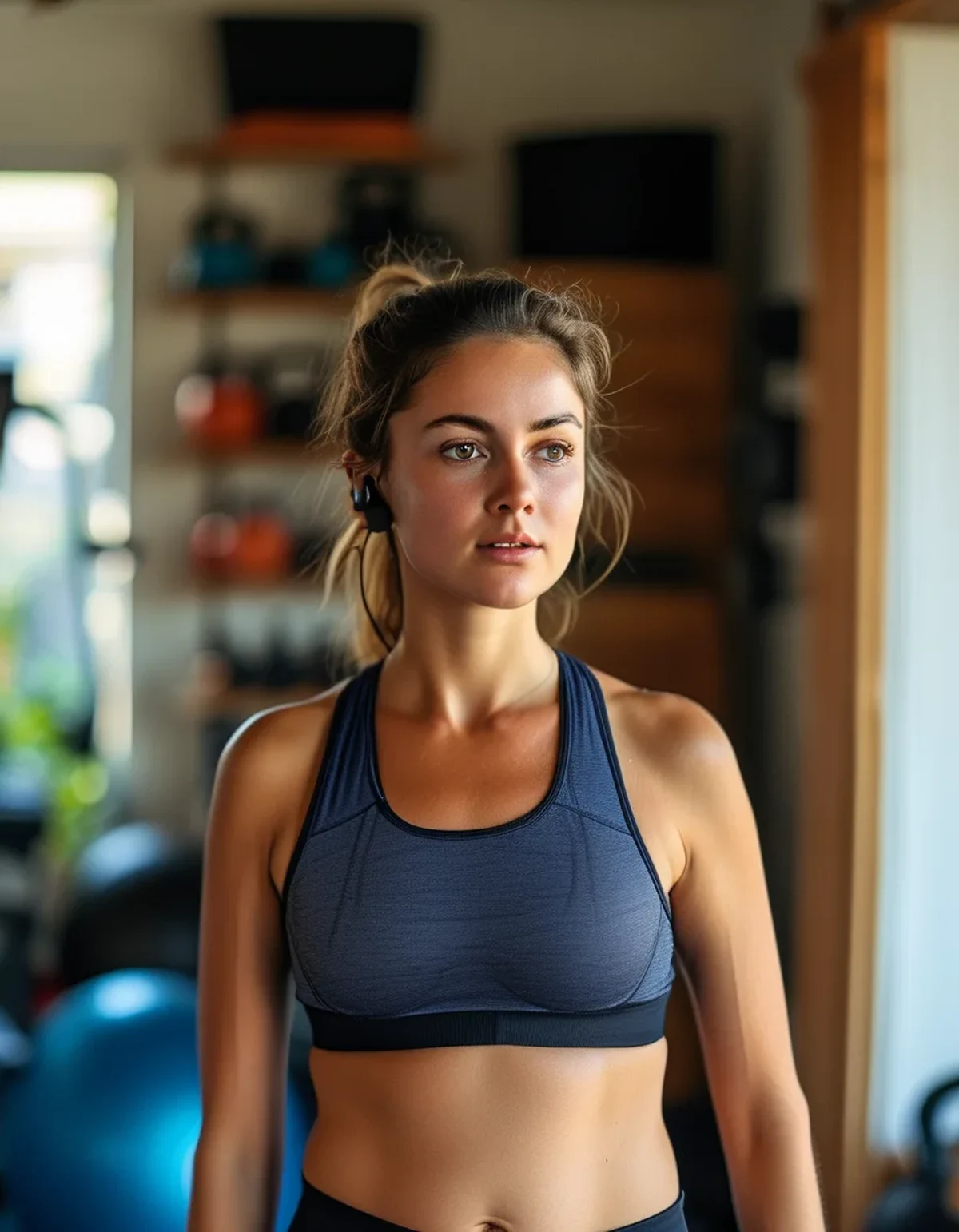
And solve the earbud fit problem properly if you go that route. Sweat plus movement is what makes earbuds fall out. Ear hooks or over-ear designs hold far better than in-ear buds for lifting and jumping, and a correctly sized ear tip matters more than the price of the earbud. Most people never try the other tip sizes in the box.
What about the hybrid setups?
Four combinations that solve the trade-off rather than picking a side.
Bone conduction headphones. They sit on the cheekbone and leave the ear canal completely open, so you keep full environmental awareness while still having personal audio. Sound quality — particularly bass — is noticeably weaker than sealed earbuds, and they leak audibly at high volume. For lifting with awareness in a shared home, they are the best available compromise.
Open-ear or transparency-mode earbuds. Transparency mode pipes ambient sound through deliberately, giving you most of the awareness back. It is not identical to genuinely open ears, and it depends on the electronics working — but it is a single-button switch, which is what makes it practical mid-session.
Speaker for lifting, headphones for cardio, in the same session. Entirely reasonable, and what many people converge on without planning it. The switch takes ten seconds between blocks.
And a small speaker at low volume plus no headphones at all. Underrated. You do not need the music loud to get most of the perceived-effort benefit — the effect does not scale simply with volume, and a modest background level plus full awareness is a genuinely good default for strength work.
One more consideration for a home gym specifically: whatever setup you choose should require zero fiddling to start. A speaker that pairs automatically when it powers on removes a small friction point from every session, and friction at the start of a session is how home gym habits quietly die.
5 Mistakes Everyone Makes With Home Gym Audio
Wearing noise-cancelling headphones under a loaded barbell. Removing environmental awareness while heavy weight is over your body or behind your neck is the one genuinely unsafe choice on this list. Use transparency mode, bone conduction, or a speaker for those lifts.
Turning it up to compensate for a bad room. More volume in a reflective garage produces more reflection, not more clarity. Fix the placement first — it is free and it works better.
Assuming headphones are quieter for the household. They are, for the music. They also make you louder — people wearing sealed earbuds count reps, breathe and drop weights considerably more loudly than they realise, because they cannot hear themselves.
Ignoring cumulative volume. A single loud session is not the problem. Sixty minutes at high volume, four times a week, for years is. Most phones will show you your average listening level; it is worth looking once.
And letting the audio setup add friction. Hunting for a charged earbud, re-pairing a speaker, finding a playlist — each is thirty seconds, and thirty seconds of friction at the start of a session is the most reliable predictor of skipping it. Set up a single playlist and a device that connects on its own.
This is general information, not medical advice — persistent ringing in the ears, muffled hearing after a session, or any change in hearing is worth getting assessed rather than adapting to.
FAQ: Home Gym Audio Questions, Answered
Are speakers or headphones better for lifting?
Speakers, primarily for awareness and because earbuds shift under load. If you must use headphones, use transparency mode.
How loud is too loud?
A practical test: if you cannot hear someone speaking normally from two metres away, it is too loud. Prolonged exposure around 85dB and above carries cumulative risk.
What tempo should my playlist be?
120-140 BPM suits most moderate work, higher for intervals. Beyond about 150 the benefit flattens for most people.
Does music actually improve performance?
It reliably reduces perceived effort at submaximal intensities and helps most in endurance and repetitive work. The effect on maximal strength efforts is small.
Where should I put the speaker?
Off the floor, out of the corner, roughly ear height, on something that isolates it from gym flooring vibration.
What about neighbours?
Bass travels through structure. Keep speakers off shared walls, use isolation pads, and set a stop time for evening sessions.
Are bone conduction headphones good enough?
For awareness in a shared home, yes — they are the best compromise available. Expect noticeably weaker bass and some leakage at volume.
Do I need a good speaker?
No. Placement and room treatment change the sound far more than price does in a small hard-surfaced room.
TL;DR:
- Speakers for lifting — awareness matters under load, and earbuds shift and fall out.
- Headphones for cardio and shared-home early mornings, where isolation lowers perceived effort.
- Music reduces perceived exertion most at submaximal intensity; 120-140 BPM covers most moderate work.
- Placement beats price: off the floor, out of the corner, ear height, isolated from gym flooring.
- If you cannot hear someone speaking from two metres away, it is too loud — and it accumulates across years.
- Bone conduction or transparency mode is the honest compromise for lifting in a shared house.
Pick the setup by session type rather than by preference. Most people already own both and use the wrong one for half their training.
Keep Reading
This article is for general informational and styling purposes only. Fit, sizing, and product availability may vary.