How Music Tempo Actually Changes Your Perceived Effort Mid-Workout (The Full Mechanism)
Quick Answer: Music tempo, measured in beats per minute, has a measurable effect on perceived exertion — faster tempo music (roughly 120-140+ BPM) tends to make the same physical workload feel less effortful than slower music, largely through a psychological distraction and pacing-cue mechanism rather than any change in actual physiological output, meaning strategic tempo selection is a genuinely useful tool for managing how hard a session feels, not just a motivational nice-to-have.
Most workout playlist advice focuses on song selection by genre or personal preference, without addressing how tempo itself interacts with effort perception during different phases of a training session.

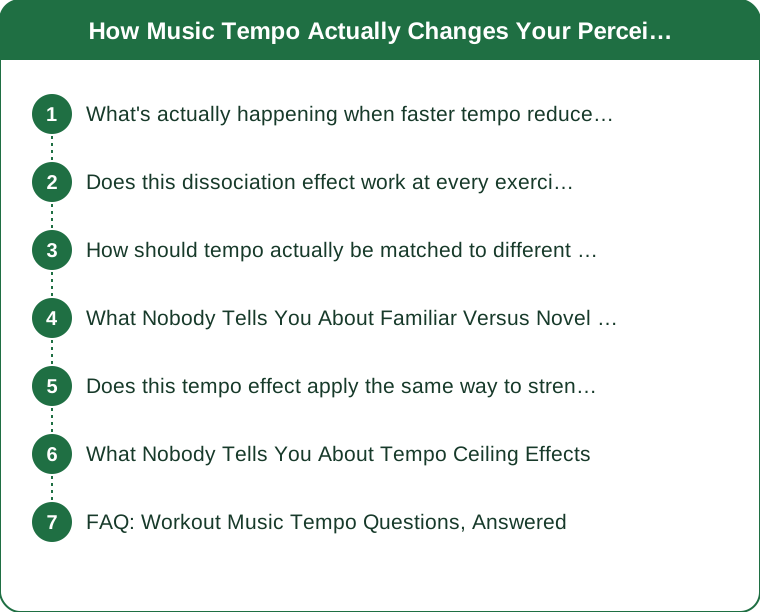
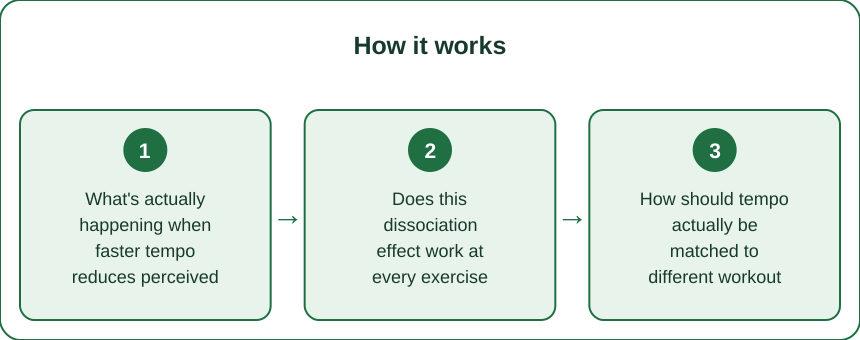
What’s actually happening when faster tempo reduces perceived effort?
Music tempo appears to work through a dissociation effect — it partially redirects attention away from internal fatigue signals (breathing rate, muscle burn) toward an external rhythmic cue, and faster tempo does this more effectively up to a point, since it provides a stronger, more continuously engaging external rhythm to sync movement and attention to than slower music does.
This dissociation effect is well-documented in exercise psychology research and is distinct from any actual physiological change — heart rate and oxygen consumption at a given workload don’t change meaningfully based on music tempo alone, but the subjective experience of that same workload does shift.
Does this dissociation effect work at every exercise intensity level?
Not equally — the effect is strongest at low-to-moderate exercise intensities, where there’s more spare attentional capacity to be redirected toward the music, and it weakens noticeably at very high intensities (near-maximal effort), where internal fatigue signals become strong enough that they’re harder to psychologically override regardless of tempo.
This is why tempo-based strategies tend to matter more for steady-state cardio or moderate-intensity strength sets than for a final maximal effort rep or an all-out sprint interval, where the physiological signal simply overwhelms any distraction effect.
How should tempo actually be matched to different workout phases?
A practical, research-supported approach is matching tempo to the phase’s intended intensity — warmup and cooldown segments benefit from slower tempo (roughly 90-110 BPM) that matches lower physical demand, the main working sets or steady cardio segment benefits from a faster synced tempo (120-140 BPM) that supports both pacing and the dissociation effect, and very high-intensity intervals can use even faster tempo (140-160+ BPM), though the benefit here is smaller given the intensity ceiling on the dissociation effect described above.
Syncing actual movement cadence (running cadence, rep tempo) to the music’s BPM, rather than just playing fast music in the background, appears to strengthen the effect further, since the rhythmic entrainment becomes more direct and physically synchronized rather than purely a background distraction.

What Nobody Tells You About Familiar Versus Novel Music
Highly familiar, well-liked music tends to produce a stronger dissociation and mood-boosting effect than unfamiliar music at the same tempo, meaning a curated, personally meaningful playlist likely outperforms a generic “high-BPM workout playlist” compiled without regard to personal preference — tempo matters, but it isn’t the only lever, and personal familiarity compounds with tempo rather than being replaceable by it.
This is part of why algorithm-generated “workout mix” playlists sometimes underperform a runner’s own long-standing favorite playlist, even when the algorithmic playlist is technically better tempo-matched to the workout phase.
Does this tempo effect apply the same way to strength training as to cardio?
The mechanism applies, but the practical application differs — for strength training, syncing rep tempo to a matching BPM during a set can help maintain consistent lifting cadence and provide the same dissociation benefit during sustained time-under-tension work, while between sets during rest, tempo matters less since the athlete isn’t in a sustained effort state requiring distraction at that moment.
For cardio, the tempo-matching benefit applies more continuously throughout a session, since cardio training is typically a more sustained effort state than the intermittent effort pattern of strength training with rest periods built in.
What Nobody Tells You About Tempo Ceiling Effects
There appears to be a point past which increasing tempo further stops improving perceived exertion and can even become counterproductive, particularly if the tempo becomes faster than a sustainable movement cadence for the specific exercise, creating a mismatch between the music’s rhythm and the body’s actual capacity that can feel jarring rather than motivating.
Finding an individual’s own sweet-spot tempo range, rather than assuming faster is always better, is a more nuanced but ultimately more effective approach than defaulting to the highest-BPM playlist available.
FAQ: Workout Music Tempo Questions, Answered
Is there an ideal single BPM number for most workouts?
There’s no single universal number, since it depends on the specific exercise and phase, but 120-140 BPM is a commonly cited effective range for moderate-intensity steady work across many training contexts.
Does this tempo effect diminish with repeated exposure to the same playlist?
Some novelty-based benefit can fade with heavy repetition, which is part of why periodically refreshing a workout playlist, even while keeping a similar tempo range, can help sustain the effect over the long term.
Should tempo selection differ for morning versus evening workouts?
There’s less direct evidence this needs to differ specifically by time of day — matching tempo to workout phase and intensity matters more than the time the workout happens.
TL;DR:
- Faster tempo music reduces perceived effort mainly through attentional dissociation, not physiological change
- The effect is strongest at low-to-moderate intensity and weakens at near-maximal effort
- Matching tempo to workout phase (slower for warmup, faster for main work) is a practical, supported strategy
- Familiar, personally liked music strengthens the effect beyond tempo alone
- There’s a tempo ceiling — faster isn’t always better once it exceeds a sustainable movement cadence
Treat tempo as a genuine training tool worth matching to each workout phase, not just a background motivational playlist choice.
Keep Reading
This article is for general informational and styling purposes only. Fit, sizing, and product availability may vary.